Why Every Revision Plan Should Include RRB Group D PYQ Book?
Preparing for the Railway Recruitment Board Level 1 Computer Based Test demands targeted revision rather than unorganised reading. An RRB Group D PYQ book serves as a proven blueprint to understand question weightage, boost speed, and clear concepts systematically. Regular practice transforms simple revision into an exam-ready strategy.
The Railway Recruitment Board Level 1 examination tests candidates across General Science, Mathematics, General Intelligence and Reasoning, and General Awareness. With 100 questions to solve in just 90 minutes, candidates often struggle with time management and conceptual application during the real Computer Based Test.
Importance of RRB Group D PYQ Book
A PYQ book consolidates authentic test papers from previous examination cycles into one structured resource. Revision without past question analysis leaves candidates unprepared for the exact framing used by the Railway Recruitment Board.
Using real papers during revision shifts focus from passive reading to active practice. Key reasons to include a dedicated book in daily study schedules include:
-
Authentic Pattern Understanding: Solved papers reveal how TCS and RRB frame questions in General Science and Mathematics.
-
Weightage Identification: Aspirants quickly identify high-yielding topics like Time and Work, Profit and Loss, and basic Physics formulas.
-
Error Elimination: Reviewing step-by-step explanations prevents recurring calculation and logical mistakes.
-
Language Familiarity: Regular practice makes reading complex reasoning stems natural and fast.
Features of RRB Group D PYQ Book
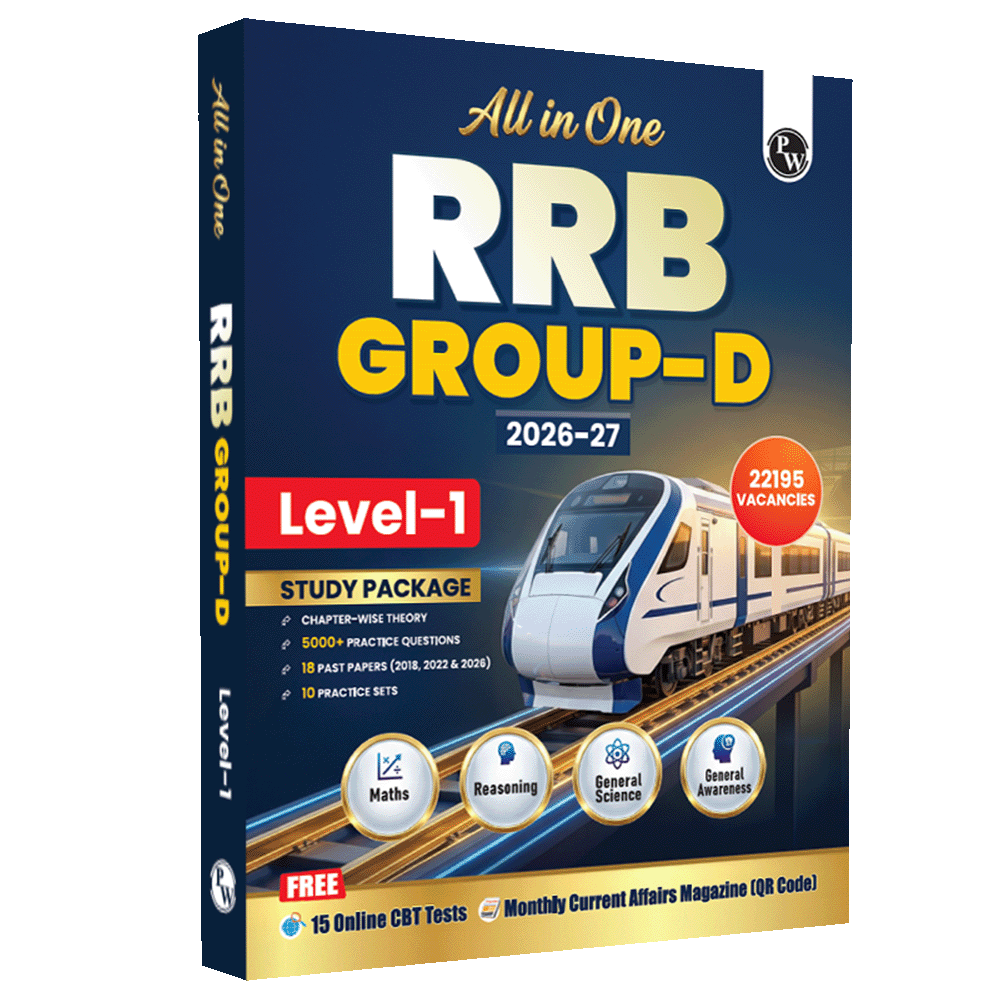
The RRB Group D PYQ resources are engineered specifically to match the current online Computer Based Test environment. The RRB PYQ Book covers solved papers from 2018 to recent shifts, offering over 3300 fully solved questions.
|
Feature |
Details in PW RRB Group D PYQ Book |
Practical Revision Value |
|
Question Volume |
3300+ fully solved practice questions |
Extensive exposure to all question types |
|
Coverage Period |
Papers from 2018, 2022, and up to 2026 |
Tracks trend shifts across multiple years |
|
CBT Practice |
15 Online Computer-Based Mock Tests |
Simulates actual exam environment and timer |
|
Explanations |
Step-by-step clear solutions |
Clears doubts without external help |
|
Supplementary Material |
Monthly Current Affairs updates |
Keeps General Awareness prep up-to-date |
How RRB Group D PYQ Book Improves Speed?
Solving 100 questions in 90 minutes leaves less than 54 seconds per question. Pure theoretical knowledge fails when candidates cannot execute solutions under tight time limits.
Strategic Benefits for Exam Speed
Working through RRB Group D previous year papers trains the mind to process questions instantly. Candidates learn to skip lengthy calculation traps and apply mental short tricks.
Enhancing Problem-Solving Accuracy
Accuracy improves when candidates understand the exact logic behind every correct option. Detailed explanations in a reliable RRB books provide alternative short methods and clarify core scientific concepts.
How to Use RRB Group D PYQ Book?
Randomly solving questions yields poor results. A structured approach ensures maximum knowledge retention and score improvement during RRB Group D preparation.
-
Chapter-Wise Verification: After finishing a theoretical chapter in Science or Mathematics, immediately solve past questions related to that topic from your railway exam practice material.
-
Timed Sets: Practice 25-question sets using a countdown timer set to 20 minutes to build real-time pacing.
-
Deep Error Analysis: Mark every wrong answer and unattempted question. Use the step-by-step explanations in your RRB Group D PYQ book to rewrite the correct solving steps.
-
Shift to CBT Tests: Transition from offline book practice to the included online CBT tests to adapt to screen reading and digital navigation.
Topic-wise Weightage of RRB Group D PYQ Book
Understanding subject breakdown helps candidates allocate revision hours effectively. Analysis of RRB Group D previous year papers reveals consistent question distribution across sections.
General Science (25 Questions)
-
Physics: Focus on Ohm's Law, Work Power Energy numericals, Lens and Mirror formulas, and Light reflection laws.
-
Chemistry: Periodic table trends, chemical reactions, acid-base properties, and common chemical formulas.
-
Biology: Human body systems, plant classification, cell structure, and life processes.
Mathematics (25 Questions)
-
Arithmetic: Time and Work, Speed Distance and Time, Percentage, Profit and Loss, Ratio and Proportion.
-
Advanced Math: Basic Algebra, Mensuration 2D/3D formulas, Trigonometric identities, and Number System simplification.
General Intelligence & Reasoning (30 Questions)
-
Analytical Reasoning: Syllogisms, Coding-Decoding, Blood Relations, and Direction Sense.
-
Non-Verbal: Mirror images, Venn diagrams, statement-arguments, and pattern completion.
General Awareness (20 Questions)
-
Static GK: Indian History, Geography basic facts, Constitution basics, and Railway organization facts.
-
Current Events: Sports awards, government schemes, appointments, and recent national events.
Read More: RRB Group D Syllabus 2026 and Subject Wise CBT Topics
RRB Group D PYQ FAQs
Why is an RRB Group D PYQ book better than plain practice sets?
A PYQ book contains real questions asked in past examinations, making it more useful for understanding the actual exam requirements. Unlike general practice sets, previous year questions show the real difficulty level, common question formats, important topics, and changing trends across different exam shifts. Regular practice with these questions also helps candidates understand which topics need more attention and which question types can be solved quickly during the exam.
How many previous year papers should be solved for RRB Group D preparation?
Candidates should aim to solve at least 30 to 33 previous year solved papers for complete practice. Working through multiple papers provides wider coverage of recurring concepts, different question formats, and variations seen across exam shifts. It also helps candidates become familiar with the overall paper structure and identify topics that appear frequently. After solving each paper, candidates should review their mistakes and revise weak topics for better results.
Does practicing RRB Group D previous year papers help in time management?
Yes, practicing RRB Group D previous year papers with a fixed time limit is an effective way to improve time management. Candidates can practise completing 100 questions within the 90-minute exam duration and learn how much time they should spend on different sections. Regular timed practice also helps reduce the time spent on difficult questions, improves question selection, and increases overall solving speed and accuracy.
Are online CBT mock tests necessary alongside an RRB Group D PYQ book?
Yes, online CBT mock tests can be useful alongside a PYQ book. Previous year papers help candidates understand question patterns and important topics, while CBT mock tests provide practice in a computer-based environment. They help candidates become comfortable with screen navigation, digital timers, question movement, and answering under real-time pressure. Using both resources gives candidates a more complete preparation experience.
How does the pw RRB Group D PYQ book assist in self-study?
The pw RRB Group D PYQ book supports self-study by providing step-by-step explanations for 3300+ questions. Candidates can check the correct method after attempting each question and understand where they made mistakes. Detailed solutions also help explain difficult concepts in a simple way, making it easier to revise without depending completely on external coaching. By regularly solving questions, reviewing errors, and revisiting weak topics, candidates can make their self-study more organised and effective.