CBSE Class 10 Social Science Geography Notes for 2026 Exam
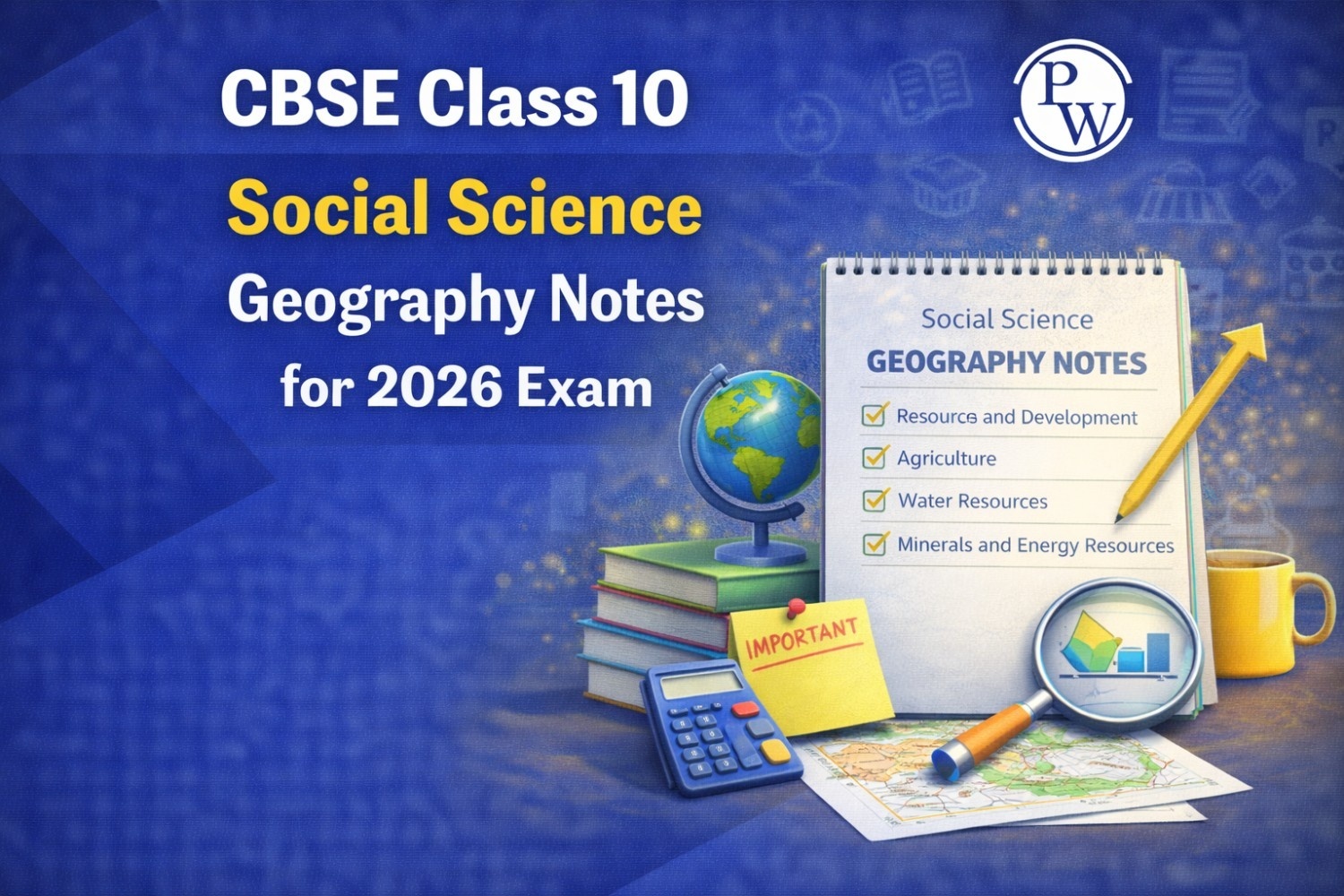
To score 95+ in the CBSE Board Exams, students must master Class 10 geography notes by focusing on Map Work, Key Definitions, and Chapter-Wise Concepts. Our ncert class 10 geography notes cover everything from Resources and Development to Lifelines of the National Economy, providing a structured path for class 10 geography board exam preparation.
Geography is often considered the most scoring part of the Social Science (SST) paper. Unlike History, which requires memorizing dates, or Civics, which focuses on theories, Geography is practical and diagram-oriented. At PW Store, we have curated these class 10 geography chapter wise notes to help you bridge the gap between reading the textbook and writing a high-scoring answer in the exam hall.
Check Out: CBSE Class 10th Books
CBSE Geography Class 10 Notes Chapter-wise
CBSE Geography Class 10 Notes chapter-wise follow the latest CBSE Class 10 syllabus and exam pattern for 2025–26. These notes are useful for last-phase preparation before the board exam:
Chapter-Wise Summary: Class 10 Geography Notes
Below is the class 10 geography quick revision notes summary for all the essential chapters as per the latest NCERT syllabus.
1. Resources and Development
This chapter is the foundation of Geography.
-
Definition: Everything available in our environment which can be used to satisfy our needs, provided it is technologically accessible, economically feasible, and culturally acceptable.
-
Classification: On the basis of Origin (Biotic/Abiotic), Exhaustibility (Renewable/Non-renewable), and Ownership.
-
Sustainable Development: Development should take place without damaging the environment.
-
Soil as a Resource: Classification of Indian Soils—Alluvial, Black (Regur), Red and Yellow, Laterite, Arid, and Forest soils.
2. Forest and Wildlife Resources
-
Biodiversity: The immense variety of flora and fauna.
-
IUCN Classification: Normal, Endangered, Vulnerable, Rare, Endemic, and Extinct species.
-
Conservation: Project Tiger (1973), Wildlife Protection Act (1972).
-
Types of Forests: Reserved, Protected, and Unclassed forests.
3. Water Resources
-
Scarcity: Despite 3/4th of the Earth being water, freshwater is limited due to over-exploitation and pollution.
-
Multi-Purpose River Projects: Dams are the "Temples of Modern India" (Jawaharlal Nehru).
-
Rainwater Harvesting: Traditional methods like Guls/Kuls (Himalayas), Khadins/Johads (Rajasthan), and Rooftop harvesting.
4. Agriculture
Agriculture is the backbone of the Indian economy.
-
Types of Farming: Primitive Subsistence, Intensive Subsistence, and Commercial Farming.
-
Cropping Seasons: Rabi (Winter), Kharif (Monsoon), and Zaid (Summer).
-
Major Crops: Rice, Wheat, Millets, Pulses (Food crops); Tea, Coffee (Beverage); Rubber, Cotton, Jute (Non-food).
-
Bhoodan-Gramdan: The Bloodless Revolution initiated by Vinoba Bhave.
5. Minerals and Energy Resources
-
Occurrence of Minerals: In Igneous/Metamorphic rocks (Lodes/Veins), Sedimentary rocks (Beds/Layers), and Alluvial deposits (Placer deposits).
-
Ferrous vs Non-Ferrous: Iron ore and Manganese vs Copper and Bauxite.
-
Energy Resources: Conventional (Coal, Petroleum, Natural Gas) vs Non-Conventional (Solar, Wind, Tidal, Geothermal).
6. Manufacturing Industries
-
Importance: Industries reduce the heavy dependence of people on agricultural income.
-
Classification: Based on raw materials (Agro-based vs Mineral-based) and Role (Basic vs Consumer).
-
Industrial Pollution: Air, Water, Thermal, and Noise pollution. Steps to control degradation.
7. Lifelines of National Economy
-
Transport: Roadways (Golden Quadrilateral), Railways, Pipelines, Waterways, and Airways.
-
Communication: Personal (Post/Telecom) and Mass Communication (Radio/TV/Press).
-
International Trade: The "Economic Barometer" of a country. Export > Import = Favorable Balance of Trade.
Check Out: CBSE Class 10th Sample Papers
Class 10 Geography Short Notes for Revision: Key Definitions
Use these class 10 geography short notes for revision to memorize terms that frequently appear in 1-mark questions:
-
Gross Sown Area: The total area sown once or more than once in a particular year.
-
Gully Erosion: Running water cuts through clayey soils making deep channels.
-
Sustainable Development: Development that meets current needs without compromising future generations.
-
Horticulture: The intensive cultivation of fruits, vegetables, and flowers.
-
Sericulture: Rearing of silkworms for the production of silk fiber.
Strategy for Class 10 Geography Board Exam Preparation
Success in Geography requires a different approach than other SST subjects. Follow these class 10 geography board exam preparation tips:
1. Master the Map Work
Map questions carry 3-5 fixed marks. Practice locating:
-
Major Dams: Bhakra Nangal, Salal, Rana Pratap Sagar, Tehri.
-
Agriculture: Leading producers of Rice, Wheat, Tea, Coffee.
-
Minerals: Iron ore mines (Mayurbhanj, Kudremukh), Coal mines (Raniganj, Neyveli).
-
Industries: Software Technology Parks and Thermal/Nuclear power plants.
2. Use Flowcharts
Geography answers look better with flowcharts. For example, when explaining the "Classification of Resources," don't just write a paragraph—draw a tree diagram.
3. Differentiate Between Topics
CBSE often asks "Distinguish between" questions. Be prepared for:
-
Bangadar vs Khadar (Alluvial soil).
-
Conventional vs Non-conventional energy.
-
Subsistence vs Commercial farming.
4. Solve Previous Year Questions (PYQs)
Many questions in Geography are repeated every 3 years. Download a class 10 geography notes pdf that includes the last 10 years of solved papers.
Check Out: CBSE Class 10 Previous Year Papers
Why Use NCERT Class 10 Geography Notes?
Students often get confused by complex reference books. However, ncert class 10 geography notes are the most reliable because:
-
Accuracy: The Board Exam paper is set based only on the NCERT textbook.
-
Language: The terminology used in NCERT is what the examiners look for in your answer sheet.
-
Diagrams: NCERT maps and pie charts are the standard for labeling in exams.
High-Weightage CBSE Class 10 Geography Chapters for 2026
Based on the class 10 geography topic wise weightage, prioritize these chapters:
-
Agriculture: 6-8 Marks (Including Map).
-
Minerals and Energy Resources: 5-7 Marks.
-
Resources and Development: 4-5 Marks.
-
Manufacturing Industries: 4-6 Marks.
Conclusion
Geography is the art of describing the Earth, but for a Class 10 student, it is the science of scoring high marks. By utilizing these class 10 geography notes, you ensure that your concepts are clear, your maps are accurate, and your revision is efficient. Remember, the key to Social Science is not just what you know, but how clearly you present it.
For more resources, sample papers, and class 10 geography short notes for revision, stay connected with the PW Store. We provide the tools you need to turn your potential into performance.
Check Out: CBSE Class 10th Question Banks
CBSE Class 10 Social Science Geography Notes FAQs
1. Are these notes enough for the 2026 Board Exams?
Yes. These class 10 geography chapter wise notes cover the entire syllabus. However, always read the NCERT textbook once to understand the context.
2. How should I revise Geography a day before the exam?
Focus on class 10 geography quick revision notes. Glance through the maps, look at the "Difference between" tables, and memorize the temperature/rainfall requirements for major crops.
3. Is map work mandatory for Geography?
Absolutely. Map work is a compulsory section in the Social Science paper. Skipping it can cost you a significant percentage.
4. Where can I find a class 10 geography notes pdf?
You can find comprehensive, downloadable study material on the PW Store website, designed specifically for CBSE toppers.
5. How can I remember the specific conditions for crops?
Create a table for crops like Rice, Wheat, and Cotton. Include columns for Temperature, Rainfall, and Soil Type. Placing this table near your study desk helps in passive memorization.