How to Revise ICSE Class 10 Maths Chapter-wise Using Question Bank
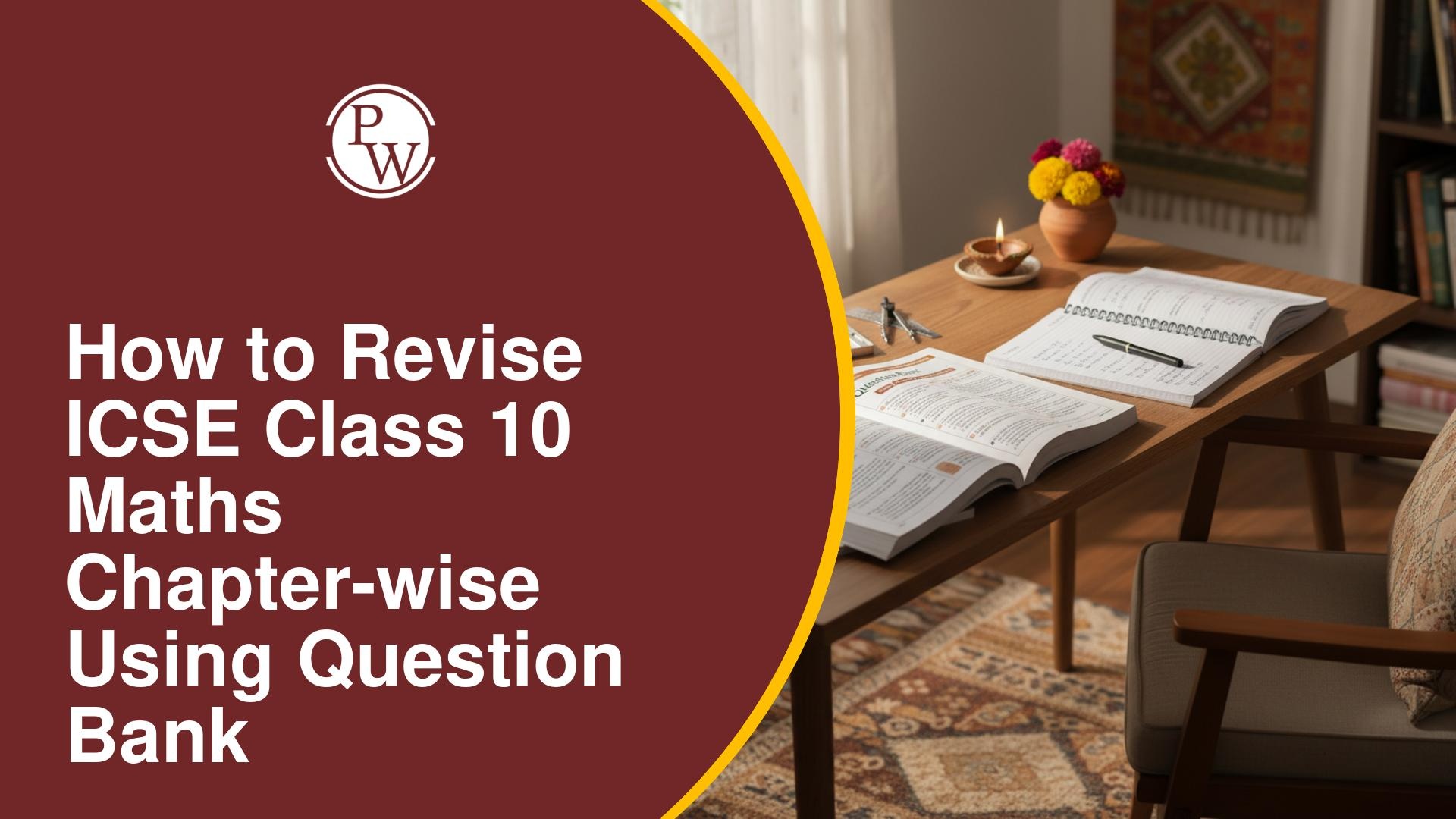
Many ICSE Class 10 students struggle to cover every mathematics topic thoroughly before board examinations. Managing lengthy formulas, varied problem types, and strict exam timing often creates last-minute stress. Relying on an ICSE Class 10 maths question bank solves this challenge by organizing your study plan chapter by chapter.
A structured revision strategy helps you identify weak spots, practise high-yield questions, and improve accuracy. Through targeted ICSE maths revision, you can convert abstract numerical concepts into predictable exam solutions.
What is an ICSE Class 10 Maths Question Bank?
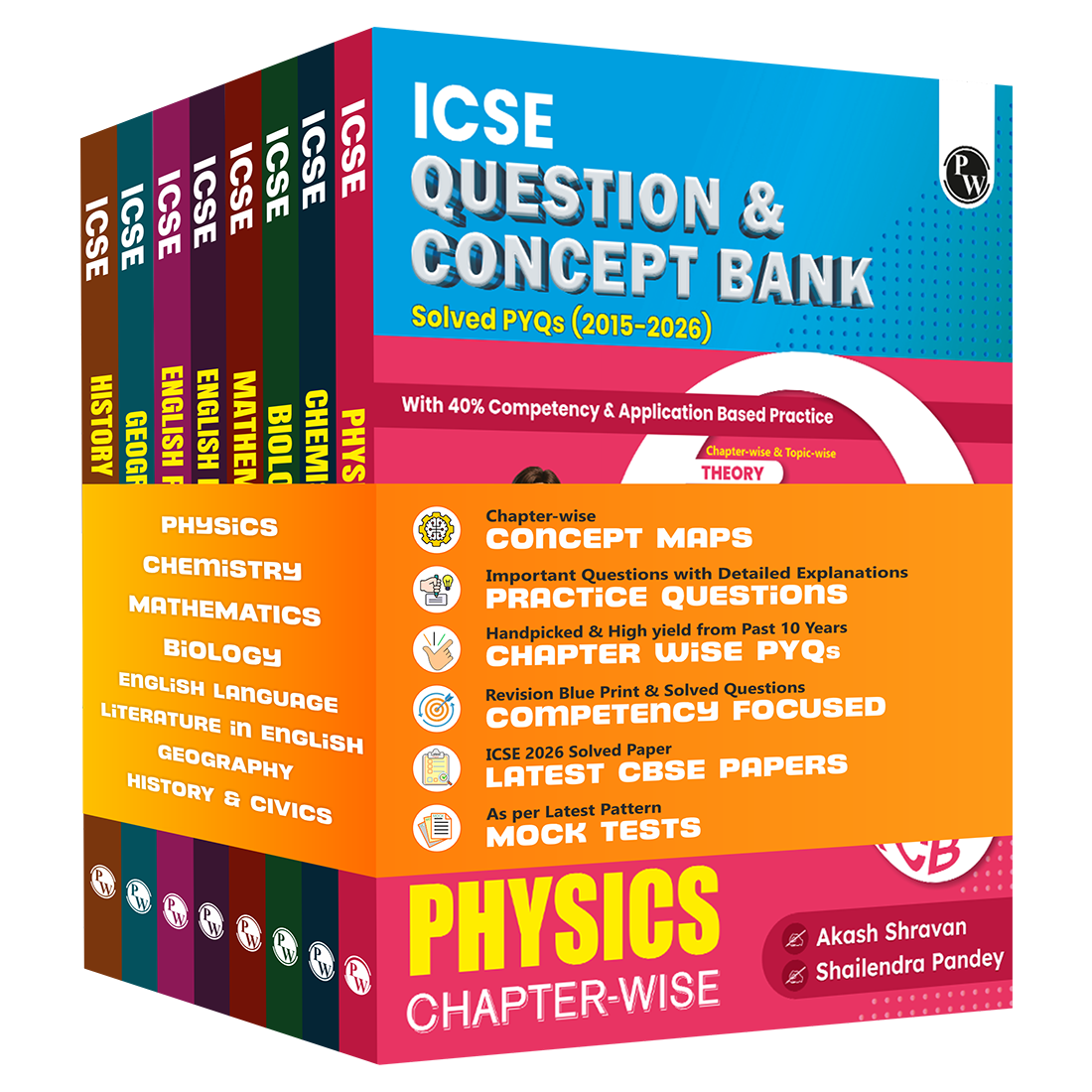
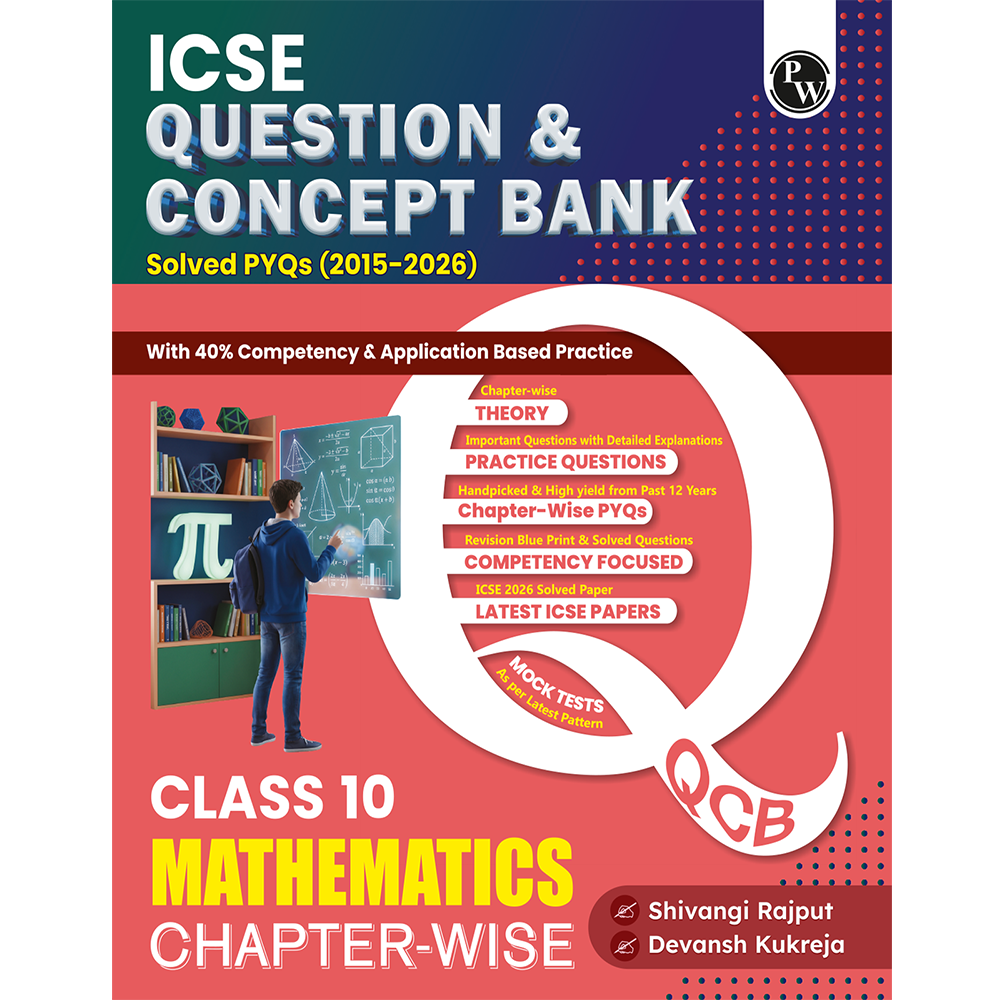
Class 10 Maths Question Bank is a useful resource for students preparing for their board exams. It provides chapter-wise and topic-wise theory, important formulas, past 12 years' high-yield questions, competency-based questions, detailed solutions, and mock tests.
Regular practice helps students understand question patterns, improve calculation accuracy, manage exam time, and identify weak topics. Using Class 10 Maths Question Bank along with textbooks and revision notes can make maths revision more organized, focused, and effective.
Features of ICSE Class 10 Maths Question Bank
Prepare for the ICSE board exams with complete study and practice material based on the latest exam pattern. This book combines chapter-wise theory, previous year questions, competency-based practice, solved papers, and mock tests for effective preparation.
Strong Concepts with Chapter-wise & Topic-wise Theory: Build a strong foundation with well-organized chapter-wise and topic-wise theory. The content helps you understand important concepts and prepare each subject step by step.
Detailed Explanations: Understand every topic with simple and clear explanations. The detailed content makes learning easier and helps improve conceptual understanding.
Past 12 Years' High-Yield Questions: Practice important ICSE Class 10 Previous Year Questions (PYQs) selected from the past 12 years. These questions help you understand exam trends, important topics, and commonly asked question types.
Competency-Based Preparation with Revision Blueprint: Improve your analytical thinking and application skills with competency-based questions. The structured revision blueprint helps you revise important topics in an organized way.
ICSE 2026 Solved Board Paper: Practice with fully solved ICSE 2026 Question Papers to understand the latest board exam pattern, question types, and difficulty level.
Latest Pattern Mock Tests: Take ICSE-style mock tests based on the latest exam format. Regular practice helps improve speed, accuracy, time management, and confidence for the final exam.
What is the Revision Strategy with ICSE Class 10 Maths Question Bank?
To maximize your performance, you need an actionable daily framework. Simply opening a book and solving questions randomly rarely yields optimal results. Integrating a systematic approach using your ICSE maths question bank makes every revision session productive.
|
Revision Phase |
Key Objective |
Primary Activity |
Output Goal |
|
Phase 1: Foundation |
Formula & Concept Clarity |
Review topic blueprints and key identities |
Zero memory gaps in basic formulas |
|
Phase 2: Practice |
Step-by-Step Execution |
Solve chapter-wise maths questions |
Complete accuracy on standard questions |
|
Phase 3: Application |
Problem Solving & Analysis |
Attempt competency and past year items |
Mastery over complex multi-step problems |
|
Phase 4: Evaluation |
Time & Speed Management |
Solve full-length solved board papers |
Flawless time allocation per section |
Step 1: Review Concise Chapter Blueprints
Before attempting any numerical problems, spend ten to fifteen minutes refreshing your memory on fundamental principles.
-
Read through the topic-wise summary provided at the beginning of the chapter.
-
Note down primary equations, geometric theorems, and algebraic identities on a separate formula sheet.
-
Ensure you understand the conditions under which specific formulas apply, such as constraints in quadratic equations or trigonometric identities.
Step 2: Solve Chapter-Wise Maths Questions Systematically
Once your theoretical foundation is clear, transition directly into active ICSE maths practice.
-
Begin with basic, direct numerical questions to gain initial momentum and confidence.
-
Move on to intermediate multi-step problems that combine two or more concepts.
-
Finish the session with high-yield previous year questions from the past 12 years to test your exam-level preparation.
Step 3: Analyze Step-by-Step Solutions and Rectify Errors
Solving the problem is only half the task; checking your method against standardized solutions completes the learning cycle.
-
Compare your written steps with the detailed solutions in the question bank.
-
Identify whether errors stemmed from calculation slip-ups, incorrect formula selection, or misinterpreting the question.
-
Maintain an error logbook where you rewrite missed questions along with the correct procedure.
Step 4: Execute Timed Practice Sessions
Mathematics papers demand both accuracy and pace. Managing eighty marks within the allotted timeframe requires deliberate practice.
-
Set a timer when working through practice sets to simulate actual examination conditions.
-
Aim to complete short two-mark questions within three minutes and longer structured questions within seven to eight minutes.
-
Use full-length mock tests periodically to test your overall stamina and section-wise time distribution.
Strengthen your board exam preparation with a ICSE Class 10 Question Bank designed for focused, exam-oriented practice. It helps students revise important concepts, practise different question types, identify weak areas, and improve accuracy and confidence before the board examinations.
How to do Chapter-Wise Practice with ICSE Class 10 Maths Question Bank?
Different branches of ICSE Class 10 Mathematics require tailored revision techniques. Categorizing chapters by topic area ensures balanced attention across the entire syllabus during your ICSE board maths preparation.
Commercial Mathematics and Algebra
Algebra and Commercial Mathematics form a substantial portion of the written paper. These chapters require rigorous step-by-step execution and algebraic precision.
-
Goods and Services Tax (GST) & Banking: Focus on computing taxable values, dividend distributions, and maturity amounts for recurring deposits. Work through varied numerical scenarios to avoid common percentage errors.
-
Linear Inequations & Quadratic Equations: Practise representing solution sets cleanly on number lines. Focus on word problems involving speed, distance, time, and work rates using structured algebraic setup.
-
Matrices & Progressions: Master matrix multiplication rules, order constraints, and determinant steps. For Arithmetic Progressions, solve problems involving $n^{\text{th}}$ terms and sum formulas.
-
Ratio and Proportion: Memorize and apply properties like Componendo and Dividendo, Alternendo, and Invertendo directly to algebraic proofs.
Geometry, Trigonometry, and Mensuration
Spatial visualization and logical deduction are essential for scoring top marks in these units.
-
Similarity & Circles: Revisit key geometric theorems concerning tangents, chords, and cyclic quadrilaterals. Write explicit geometric reasons alongside every step in your proofs.
-
Trigonometry: Solve questions involving trigonometric identities, height and distance calculations, and angle of elevation/depression diagrams. Ensure your geometric sketches are neat and accurately labeled.
-
Mensuration: Focus on combinations of solids involving cylinders, cones, and spheres. Keep a dedicated checklist of formulas for surface area, volume, and total surface area to prevent formula confusion.
Coordinate Geometry, Statistics, and Probability
These units offer reliable scoring opportunities if calculation accuracy is maintained.
-
Reflection & Section Formula: Practise plotting points on graph sheets, identifying invariant points, and applying the section and midpoint formulas cleanly.
-
Equation of a Line: Master finding slopes using parallel/perpendicular conditions, point-slope forms, and intercept forms.
-
Statistics & Probability: Practise constructing ogives, histograms, and calculating the mean, median, and mode using step-deviation methods. Verify all probability fractions carefully to avoid basic reduction errors.
Why Choose ICSE Class 10 Maths Question Bank for Revision?
Revising mathematics requires active problem-solving rather than passive reading. Standard textbooks present core concepts effectively, but they often lack the exam-focused categorization needed during final preparation. Utilizing a dedicated Class 10 maths question bank ensures that every hour of study directly contributes to board performance.
Structured Chapter-Wise and Topic-Wise Theory
A well-organized question bank breaks each chapter into distinct topics. Instead of tackling an entire module at once, you can focus on specific sub-topics where you feel less confident.
-
Focused Summaries: Concise theory blueprints help you review key definitions, identities, and formulas in minutes.
-
Targeted Learning: Topic-wise divisions prevent overwhelm by isolating specific question styles.
-
Quick Reference: Essential properties and theorems are placed right before practice sets for immediate application.
Practice Past 12 Years High-Yield Questions
Board examination patterns often repeat specific question structures across different years. Studying past questions provides a realistic view of how examiners test core concepts.
-
Pattern Recognition: Working with past 12 years' questions highlights recurring problem types across all chapters.
-
Marking Scheme Awareness: Detailed explanations illustrate how step-wise marking is applied in actual board evaluation.
-
Weightage Insight: Chapter-wise compilation clarifies which topics carry higher mark allocations in the question paper.
Build Competency with Application Questions
Modern board assessments place significant emphasis on application-based and analytical thinking. Relying solely on direct numerical problems is no longer sufficient.
-
Real-World Contexts: Competency-based items present mathematical problems framed within practical scenarios.
-
Analytical Growth: Multi-step problems test your capability to link concepts from different subtopics.
-
Exam Readiness: Exposure to varied question formats eliminates unexpected surprises during the final test.
Mistakes to Avoid While Using ICSE Class 10 Maths Question Bank
Even with access to a quality ICSE Class 10 Books, ineffective revision habits can undermine your progress. Avoiding common traps keeps your preparation efficient and results-oriented.
Reading Solutions Instead of Writing Them
The most frequent error in mathematics revision is passively scanning written answers.
-
Reading a solution creates a false sense of mastery that vanishes during an actual test.
-
Always pick up a pen and work through complete solutions from start to finish on paper.
-
Ensure every intermediate algebraic calculation and statement is written down explicitly.
Skipping Step-wise Working and Reasons
ICSE board evaluation assigns specific marks to intermediate steps and mathematical statements.
-
Skipping preliminary steps or missing units in final answers leads to avoidable mark deductions.
-
Omitting geometric theorem justifications in circle or similarity proofs reduces overall scores.
-
Use the official solutions in your question bank as a model for standard step presentation.
Ignoring Weak Chapters or Hard Questions
Students often spend excessive time solving easy questions in familiar chapters while avoiding challenging topics.
-
Identify difficult topics early in your revision cycle rather than postponing them to the final days.
-
Allocate extra time to work through solved examples in challenging units before attempting practice sets.
-
Revisit complex problems repeatedly until you can solve them independently without checking the answer key.
Read More: Study Time Table for ICSE Class 10 Exam
ICSE Class 10 Maths FAQs
How does a Class 10 maths question bank help in board revision?
It categorizes the syllabus into structured chapter-wise and topic-wise units, providing concise theory, past 12 years questions, and fully solved answers that help students practice systematically and master step-wise marking.
How many years of past questions should I solve for ICSE Class 10 Maths?
Solving past 12 years high-yield questions provides complete exposure to recurring question formats, board marking schemes, and topic weightage required for thorough preparation.
Can I rely on a question bank for last-minute ICSE maths revision?
Yes, a quality question bank includes topic-wise blueprints, quick theory summaries, solved board papers, and mock tests that allow for rapid formula review and targeted problem practice.
Why are competency-based questions important in ICSE Class 10 Maths?
Competency-based questions test real-world application and analytical thinking rather than simple rote memorization, helping students prepare for modern ICSE board paper patterns.
How should I manage time while practicing chapter-wise maths questions?
Time yourself using a stopwatch during practice sessions, aiming for about 1.5 minutes per mark, and regularly complete full-length mock tests to refine speed and section-wise pacing.