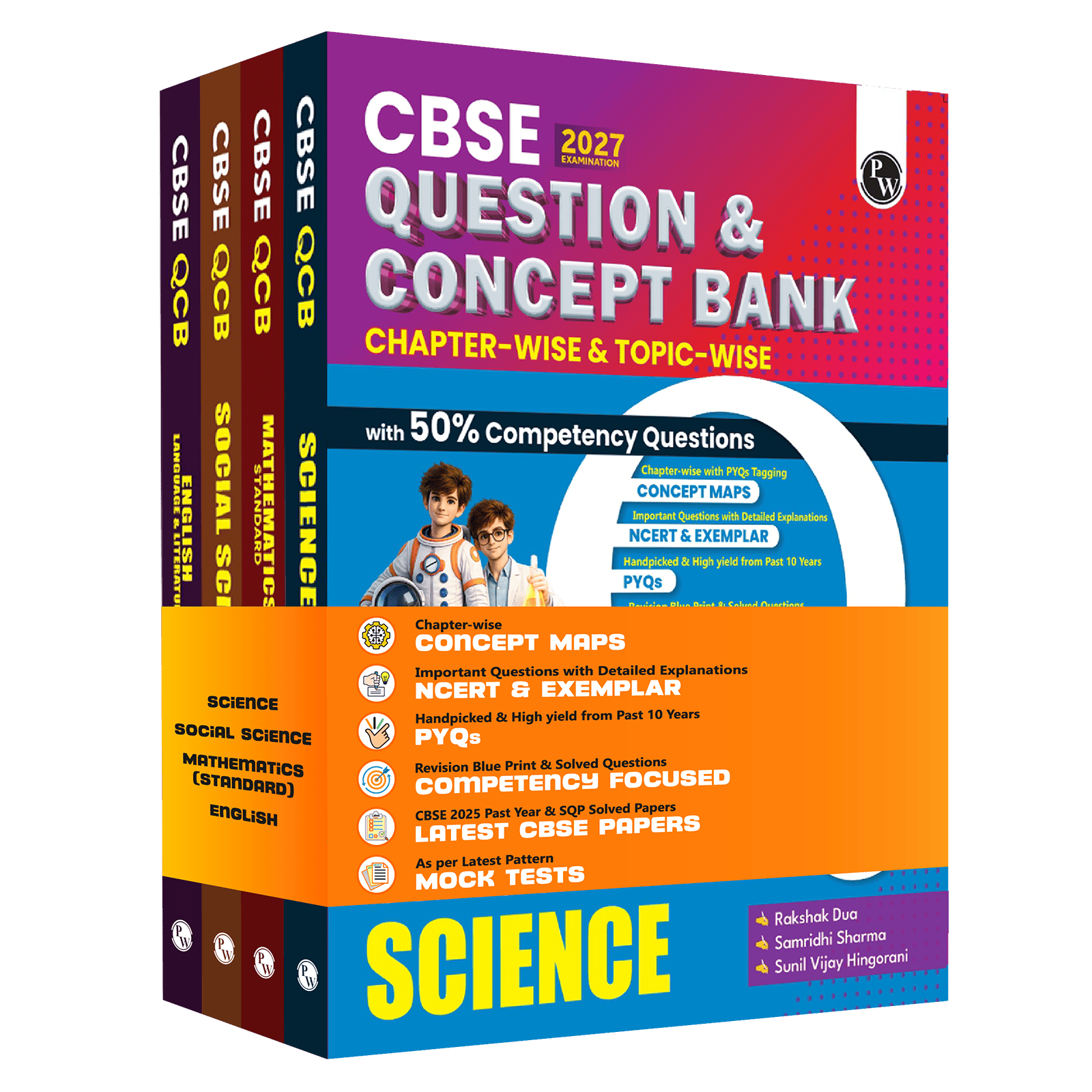
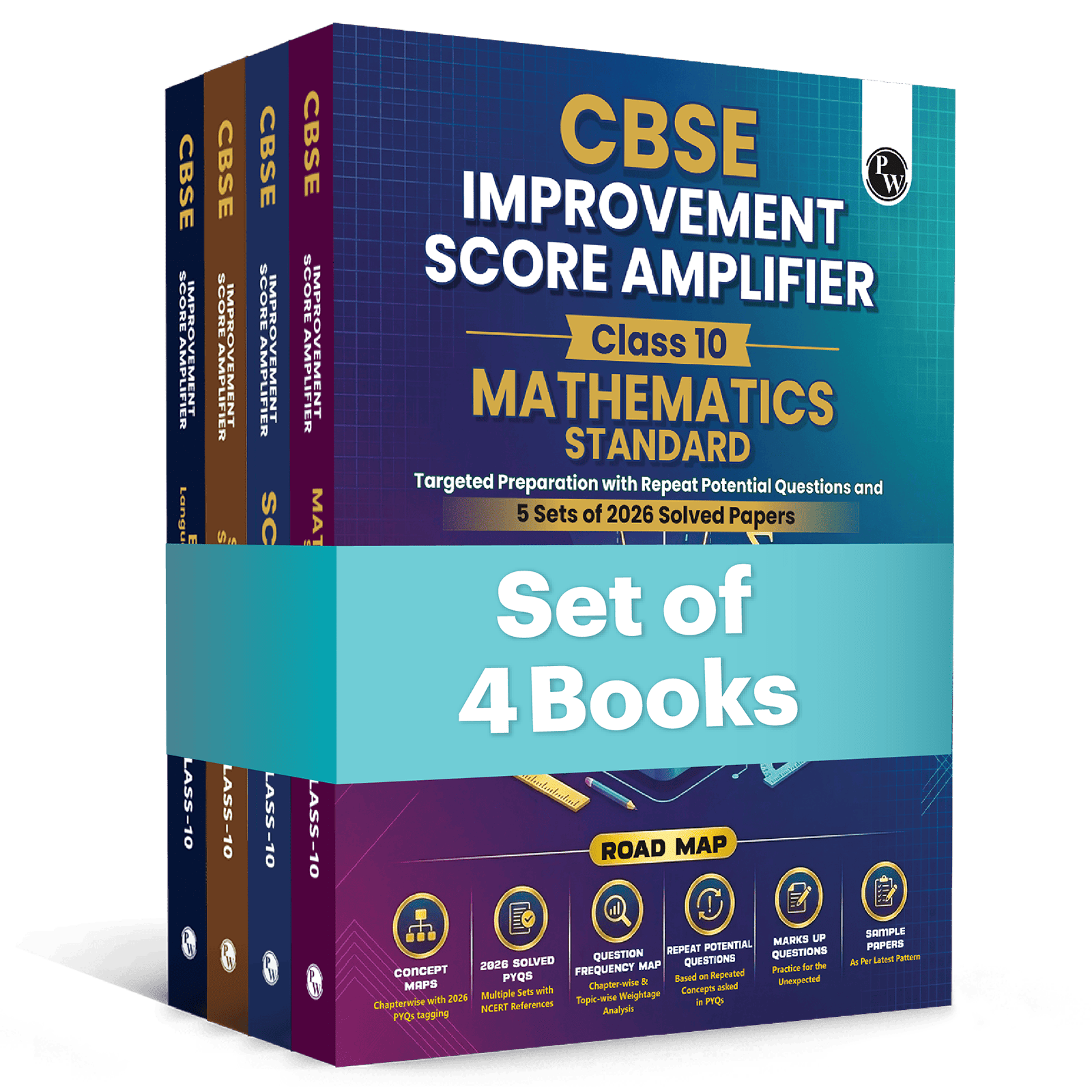
How to Become Average to Topper Using CBSE Class 10 Question Bank

Cracking the CBSE Class 10 question bank is the secret to jumping from average scores to high scores. By practising real exam patterns, identifying recurring topics, and using structured resources like the PW question bank, students can bridge the gap between "knowing" and "scoring".
Check Out: CBSE Class 10 Books
Why Students Struggle to Score High in CBSE Class 10?
Many students work incredibly hard, yet their marks remain stuck in the 60% to 70% bracket. This is a common frustration for Class 10 students who read their textbooks cover to cover but struggle during the actual exam. The problem isn't a lack of effort; it is a lack of strategic practice. Reading a chapter gives you knowledge, but the Class 10 question bank gives you the ability to apply that knowledge under pressure.
To move from an average performer to a topper, you need to shift your focus from passive reading to active solving. The board exams are as much about "exam temperament" as they are about syllabus coverage.
Importance of CBSE Class 10 Question Bank
A standard textbook provides the theory, but it often lacks the variety of questions seen in the boards. This is where the CBSE class 10 question bank steps in. It acts as a bridge between your school notes and the final answer sheet.
2026 CBSE Exam Pattern
The CBSE question bank 2026 is specifically designed to align with the latest Competency-Based Education (CBE) guidelines. This means questions are no longer just direct definitions; they require critical thinking. Using a dedicated question bank for class 10 PDF or a physical book form allows you to:
-
Practise every subject in a focused way: It gives chapter-based questions for Mathematics, Science, Social Science, English, and Hindi, making subject-wise revision more organised.
-
Understand exam patterns better: Students become familiar with case-based, assertion-reason, MCQ, and subjective questions often seen in board exams.
-
Improve time management: Regular timed practice helps students learn how much time to spend on each section.
-
Build confidence through repetition: Solving a wide range of questions reduces hesitation and makes students feel more prepared for the final paper.
-
Revise weak areas properly: A question bank helps students notice which chapters or question types need extra attention.
-
Use textbooks more effectively: While textbooks build concepts, question banks strengthen application and answer-writing skills.
-
Prepare with previous year and sample-style questions: This gives students a clearer idea of the level, style, and structure of the actual exam.
-
Identify high-weightage chapters: Some chapters appear more often or carry more marks, so targeted practice becomes easier.
Step-by-Step Strategy Using CBSE Class 10 Question Bank
1. Start with Chapter-wise Analysis
Don't jump into full-length papers immediately. Use the PW question bank to solve questions chapter by chapter. Once you finish "Chemical Reactions and Equations" in Science, go straight to the question bank. This reinforces the concepts you just learned.
2. Decode the "Repeated" Questions
If you look at the question bank over the last five years, you will notice a pattern. Certain concepts like "Ohm’s Law" or "The Rise of Nationalism in Europe" appear almost every year in different forms. Toppers identify these "sure-shot" topics and master them perfectly.
3. Practice Topper Answer Sheets
A high-quality question bank often includes model answers. Comparing your handwritten answers with these models helps you understand where you are losing marks, whether it is due to a lack of keywords, poor diagrams, or disorganised steps in math.
4. Use the Active Recall Method
After completing a chapter, close your notes and solve questions directly from the question bank. This strengthens memory retention and ensures you can recall concepts during exams without hints.
5. Apply Spaced Revision
Instead of revising a chapter once, revisit it after 3 days, 7 days, and 15 days using the question bank. This technique helps move concepts from short-term to long-term memory.
6. Create Exam Conditions at your Home
Set a timer and solve sections or full papers from your Class 10 question bank in a distraction-free environment. This builds speed, accuracy, and exam confidence.
Check Out: CBSE Class 10th Previous Year Papers
Marking Scheme Strategy CBSE Question Bank Class 10
The following table breaks down how you should allocate your time and effort based on the structure provided in a premium question bank class 10.
|
Question Type |
Time Allocation |
Strategy for Maximum Marks |
|
MCQs / Objective |
1 Minute per quest. |
Use the elimination method; focus on NCERT lines. |
|
Short Answer (2-3 Marks) |
3-5 Minutes |
Use bullet points; include 1-2 core keywords. |
|
Long Answer (5 Marks) |
10-12 Minutes |
Start with a definition; include a neat diagram. |
|
Case-Based Study |
8 Minutes |
Read the passage last; focus on the data provided. |
How to Use the PW Question Bank Class 10 Effectively?
The PW question bank is designed to take the stress out of preparation. Here is how you can integrate it into your daily routine:
-
The 30-Minute Drill: Every evening, pick five random questions from the question bank and solve them without looking at your notes.
-
Focus on Mistakes: Use a highlighter to mark questions you got wrong. Revisit these every Sunday.
-
Digital Integration: If you use a PDF, ensure you are practising on paper too. Writing helps with muscle memory for the 3-hour-long exam.
How to be Consistent with CBSE Question Bank Class 10?
Success isn't built in a week. Toppers are consistent. They don't wait for the "pre-board" month to open their question bank. They start early, usually by the middle of the academic session. By the time the final exams arrive, they have solved every question in their PW question bank class 10 at least twice.
Quick Tips for Fast Revision
-
Formula Sheets: Keep a small notebook for math and physics formulas found in your question bank.
-
Keyword Underlining: In social science and biology, underline the technical terms in the question bank's answers. Use these same terms in your exam.
-
Diagram Practice: Never skip the diagrams in the question bank. A well-labelled diagram can often fetch you full marks even if your explanation is brief.
Check out: CBSE Class 10 Sample Papers
Final Checklist For Using CBSE Class 10 Question Bank
To ensure you are on the right track, keep this checklist in mind while using your question bank:
-
Have I completed the NCERT exercises first?
-
Am I solving the "Very Short Answer" questions to build speed?
-
Did I check the marking scheme provided in the PDF?
-
Am I practising at least two case-based questions daily?
-
Have I updated my prep based on the CBSE Class 10 question bank 2026 latest updates?
By shifting your focus to high-quality practice through the PW question bank, you eliminate the "fear of the unknown." You go into the exam hall knowing exactly what kind of questions you will face. That confidence is the hallmark of a topper.
Read More: CBSE Class 10 Question Bank PDF Download
CBSE Class 10 Question Bank 2026 FAQs
Is the CBSE Class 10 question bank enough for 95%?
While the question bank is essential for practice, you should always start with NCERT. Once concepts are clear, the CBSE Class 10 question bank is the best tool to reach that 95% mark.
When should I start solving the question bank?
The ideal time to start using a question bank is immediately after finishing a chapter. Don't wait for the entire syllabus to end.
Does the CBSE question bank 2026 include solved papers?
Yes, most reputable versions include previous year solved papers and the latest 2026 sample papers.
Where can I find a question bank for class 10 PDF?
You can find official samples on the CBSE website, but for a structured experience with detailed solutions, the PDF versions are often available on educational websites.