24 Years of CTET Maths & Science PYQs: What Should You Actually Analyse?
A solid grasp of upper primary concepts is critical when tackling CTET Paper 2. Many candidates spend hours reading endless notes, yet they struggle when facing actual questions in the exam hall. Bridging this gap demands more than just casual reading; it requires systematic paper analysis.
By examining past trends, you can easily filter out low-yield topics and focus directly on high-weightage concepts. Working through previous CTET Maths Science PYQ Book builds practical familiarity with the evaluation pattern, ensuring you do not lose marks on conceptual traps or time management.
Importance of the CTET Maths Science PYQ Book
Using a dedicated CTET maths science PYQ book removes guesswork from your preparation journey. Solving past papers exposes recurring patterns across both subjects. It helps candidates separate high-frequency concepts from low-yield topics.
Detailed explanations convert every mistake into an active learning moment. When you analyze past questions, you learn how examiners frame distractors, especially in pedagogical sections where options look similar.
-
Identifies Recurring Concepts: Highlights topics that appear consistently year after year.
-
Improves Conceptual Clarity: Step-by-step solutions explain fundamental rules instead of forcing rote learning.
-
Refines Time Management: Practicing authentic items trains candidates to solve complex calculations within limited timeframes.
-
Eliminates Exam Anxiety: Working through real papers gives you a clear picture of what to expect on test day.
Features of CTET Maths Science PYQ Book
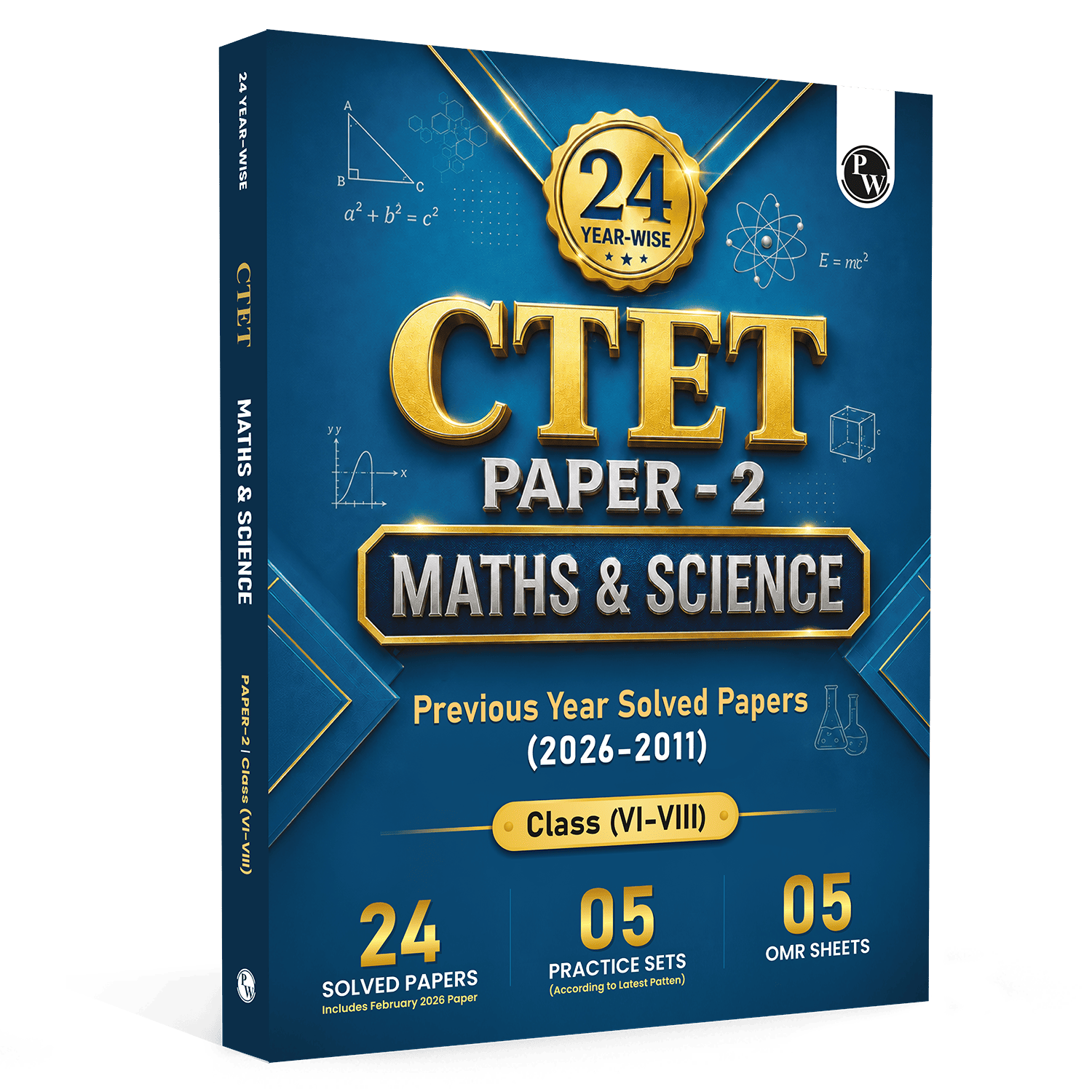
A reliable CTET maths science PYQ book serves as a single, comprehensive compilation for candidates preparing for upper primary classes (6 to 8). It consolidates 24 yearwise previous year solved papers spanning from 2026 back to 2011. This structured repository allows aspirants to trace how the difficulty level and framing of questions have evolved over time.
Rather than presenting isolated answer keys, this CTET PYQ resource equips learners with step-by-step detailed explanations for every problem. This setup helps candidates evaluate the exact logic behind every correct option.
-
24 Yearwise Solved Papers (2026–2011): Complete historical collection of previous papers with clear, step-by-step solutions.
-
4350+ Practice Questions: A huge question bank covering the full syllabus comprehensively.
-
5 Full-Length Practice Sets: Model papers curated according to the latest paper layout for effective self-assessment.
-
5 OMR Sheets: Realistic offline exam simulation tools to refine bubble-filling speed and reduce marked errors.
|
Feature |
Details |
Benefit for Aspirants |
|
Coverage Period |
24 Years (2026–2011) |
Helps track long-term question shifts |
|
Question Count |
4350+ Practice Questions |
Ensures rigorous coverage of concepts |
|
Explanations |
Step-by-Step Detailed Solutions |
Strengthens conceptual clarity |
|
Mock Simulation |
05 Practice Sets & 05 OMR Sheets |
Builds exam confidence and speed |
When to Use the CTET Maths Science PYQ Book
Timing your practice properly ensures maximum retention and performance gains. Integrating a CTET maths science PYQ book at the right stage of your preparation prevents burnout and reinforces core learning.
-
Early Phase (Topic-Wise Review): Use the book right after finishing a chapter from NCERT textbooks to see how questions are framed from that specific topic.
-
Mid-Preparation (Trend Analysis): Solve complete yearwise papers to identify weak areas and refine problem-solving speed.
-
Final Phase (Full-Length Simulation): Use the included practice sets along with OMR sheets during the final weeks to simulate real exam conditions.
Topics To Analyse in the CTET Maths Science PYQ Book
To score well in CTET paper 2 maths science, you must focus on the highest-yielding topics. Analysing a CTET maths science PYQ book reveals specific chapters that carry significant weight.
Mathematics Focus Areas
-
Number System & Arithmetic: Practice questions on prime numbers, fractions, LCM/HCF, ratios, and percentages.
-
Algebra: Master basic identities, linear equations, and simple sequence patterns.
-
Geometry & Mensuration: Focus on 2D and 3D shapes, area, perimeter, surface area, and volume formulas.
-
Mathematics Pedagogy: Study the nature of mathematics, logical thinking, diagnostic testing, and error analysis.
Science Focus Areas
-
Food & Materials: Cover sources of food, components of food, and physical or chemical changes in materials.
-
The World of the Living: Concentrate on plant and animal life, human physiology basics, cells, and ecosystems.
-
Natural Phenomena & How Things Work: Review concepts of light, reflection, sound, force, motion, electric circuits, and magnets.
-
Science Pedagogy: Focus on inquiry-based learning, scientific temper, practical experimentation, and continuous evaluation.
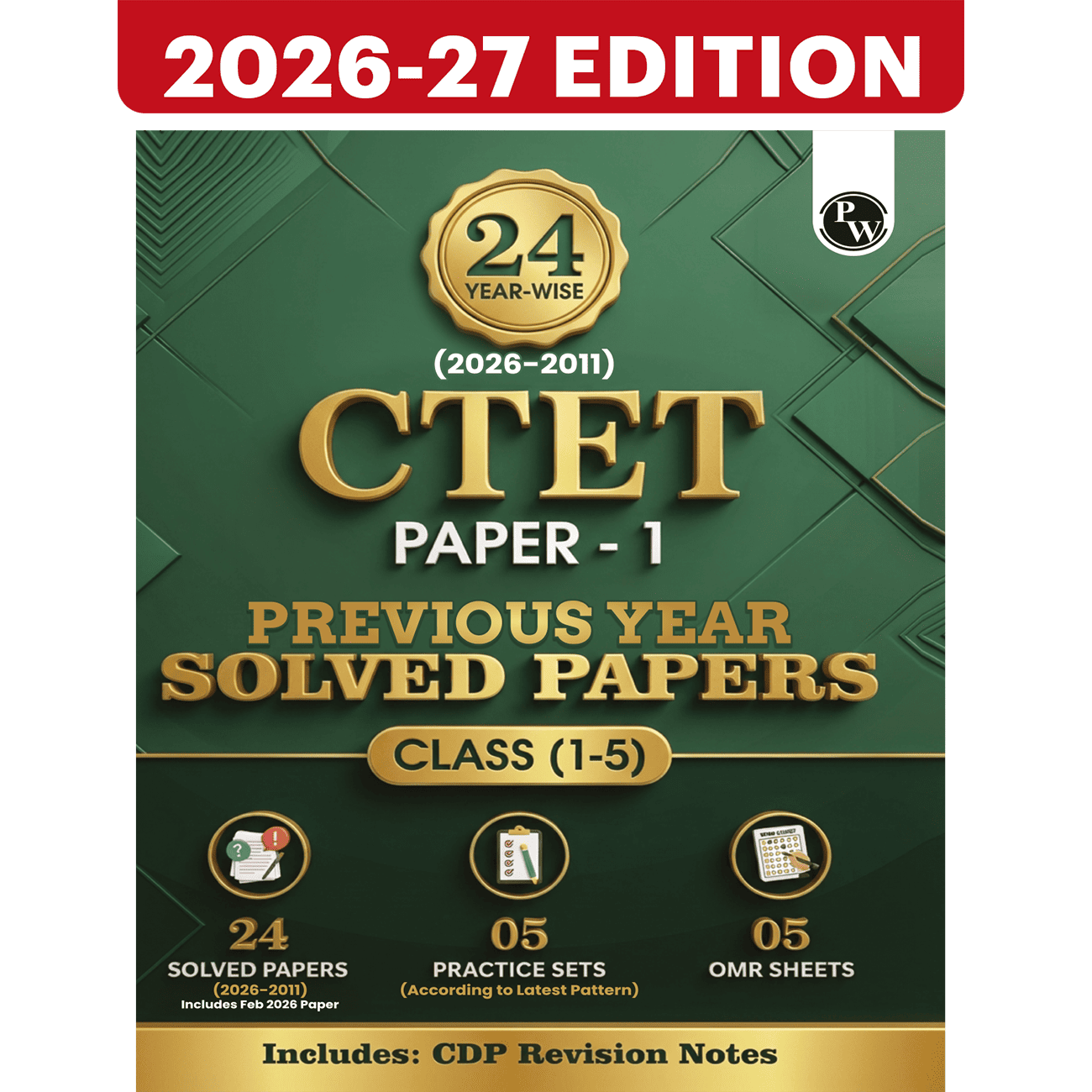
Also Check - PW CTET Paper 2 Social Science Book
Study Plan for the CTET Maths Science PYQ Book
A structured timeline helps you cover 24 years of questions systematically without getting overwhelmed. Follow this balanced plan to organize your CTET PYQ practice:
-
Weeks 1 to 4 (Foundational Analysis): Solve papers from 2011 to 2017. Focus on understanding step-by-step solutions for basic concepts.
-
Weeks 5 to 8 (Advanced Trend Mapping): Solve papers from 2018 to 2022. Pay special attention to modern pedagogical scenario questions.
-
Weeks 9 to 10 (Recent Papers & Weak Area Fixes): Complete papers from 2023 to 2026. Bookmark every incorrect question and review corresponding NCERT chapters.
-
Weeks 11 to 12 (Full Mock Simulation): Attempt the 05 full-length practice sets using OMR sheets under strict timed conditions.
Practice Sheets Preparation with the CTET Maths Science PYQ Book
Solving questions mentally or on scrap paper often creates a false sense of security. Real exam conditions require accuracy and proper time management on physical sheets.
-
Simulating Offline Conditions: Using actual OMR sheets trains you to shade bubbles neatly without misaligning question numbers.
-
Tracking Speed & Accuracy: Timing your attempt across full practice sets helps you calculate how much time you spend on calculations versus pedagogical reasoning.
-
Evaluating Progress: Comparing scores across practice sets highlights measurable improvements and pinpoints areas needing extra attention.
Tips to Revise With the CTET Maths Science PYQ Book
Revision should be an active process of solving problems, not passive reading. Use your CTET maths science PYQ book as a dynamic revision tool.
-
Maintain an Error Notebook: Note down every mistake made during practice, along with the correct underlying formula or concept.
-
Focus on Step-by-Step Logic: Review the detailed solutions to learn alternate, quicker problem-solving approaches.
-
Re-solve Bookmarked Questions: Regularly re-attempt flagged CTET maths questions and CTET science questions every fortnight to build mastery.
-
Combine Pedagogy & Content: Alternate between calculation problems and pedagogy items to build mental agility for the real paper.
-
Solve Under Time Constraints: Set a timer for 15-minute sprints to practice solving 15 questions rapidly without compromising accuracy.
Read More: CTET Previous Year Question Papers with Solutions, Download PDF
CTET Maths Science PYQ FAQs
Why is a CTET maths science PYQ book essential for CTET Paper 2?
A CTET maths science PYQ book helps candidates understand the exam pattern, spot recurring question trends, and build conceptual clarity through step-by-step solutions.
How many years of previous papers should I solve for CTET Paper 2?
Solving 24 years of previous papers (2026–2011) provides complete coverage of the syllabus and helps you adapt to all variations of CTET previous year questions.
How do detailed solutions in PYQ books help in preparation?
Detailed solutions explain the exact logic behind every correct answer, helping you correct mistakes, clarify concepts, and improve problem-solving accuracy.
How do OMR sheets included in the book assist aspirants?
Practicing with offline OMR sheets mimics the real examination environment, improving your bubble-marking speed and minimizing errors on test day.
What is the best way to revise using past year papers?
Maintain a dedicated error log, re-solve bookmarked items, and attempt full-length practice sets under timed conditions to maximize retention and speed.