Why Choose PW UGC NET Geography PYQs?

A common challenge faced during revision is managing massive subject syllabi without knowing which specific sections carry maximum weightage in actual tests. Studying entire textbooks repeatedly often leads to burnout rather than actual progress.
Success requires a practical strategy that focuses on authentic exam patterns. Utilizing dedicated past paper compilations allows candidates to pinpoint high-yield sections, understand shifting test trends, and refine question-solving speed. Using a targeted UGC NET geography pyq compilation acts as a reliable guide throughout your UGC NET geography preparation.
What Is UGC NET Geography PYQ?
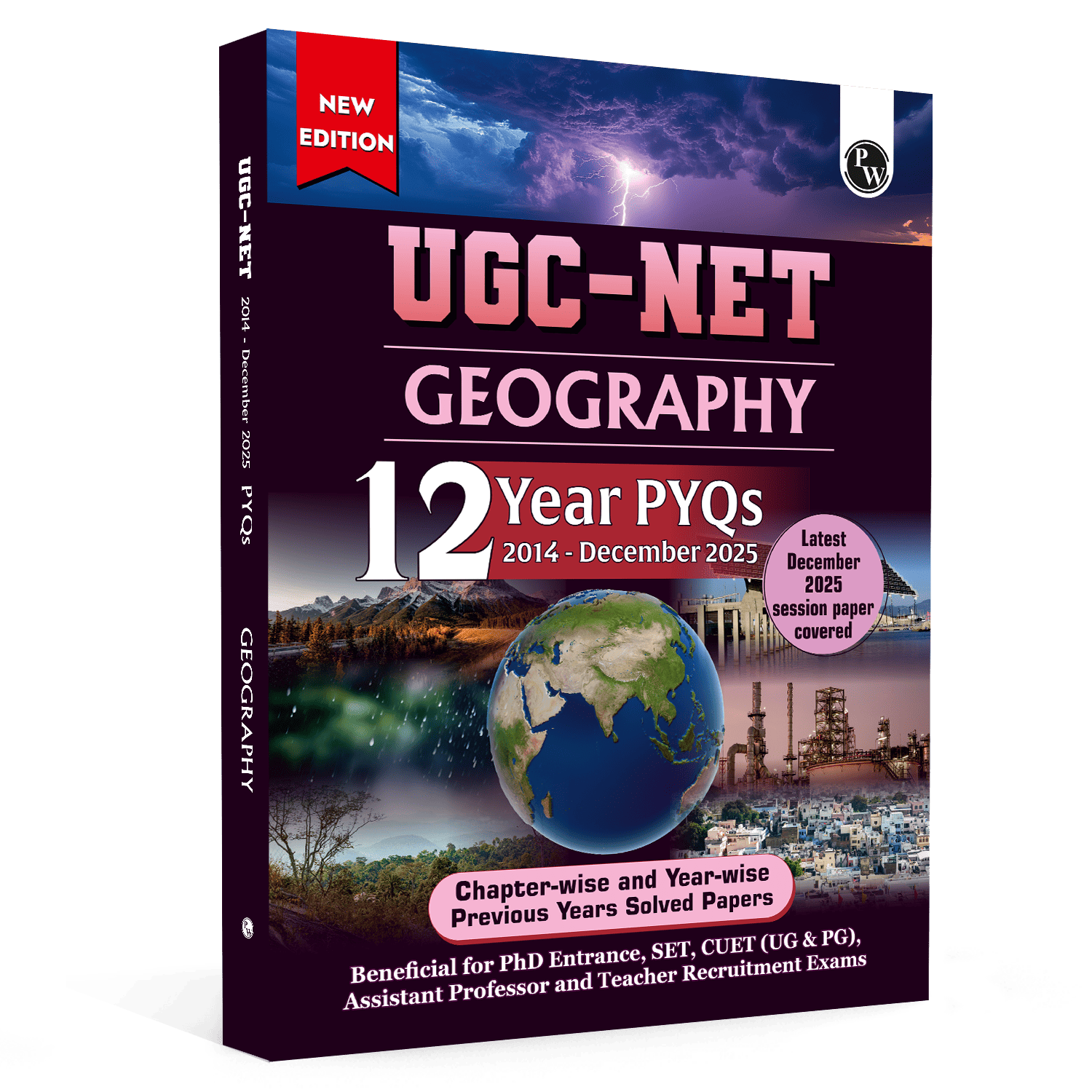
A UGC NET geography pyq compilation brings together previous year question papers collected across multiple exam cycles, covering 12 years of tests from 2014 to 2025. These past papers serve as direct historical records showing how theoretical concepts translate into real test items.
Unlike basic question banks, authentic geography previous year papers provide real assessment contexts. Key structural features include:
-
Comprehensive Year Coverage: Includes recent December 2025 session papers along with papers going back to 2014.
-
Dual Organization Options: Offers both chapter-wise geography pyqs for topic targeted practice and year-wise solved papers for full test simulation.
-
Detailed Answer Explanations: Provides thorough reasoning and logical background for solutions rather than just listing answer keys.
-
Exam Trend Analysis: Features analytical charts and breakdowns highlighting changing focus areas and recurring concepts.
Why Choose UGC NET Geography PYQ for Preparation?
Selecting a reliable geography pyq book simplifies study routines by transforming unstructured reading into strategic practice. Relying on structured geography solved papers builds conceptual accuracy and test familiarity.
Key Benefits of PYQ Practice
|
Feature |
Preparation Impact |
Primary Advantage |
|
Trend Analysis |
Identifies recurring high-yield topics |
Prioritizes crucial syllabus areas |
|
Detailed Explanations |
Explains reasoning behind answers |
Builds deeper conceptual clarity |
|
Dual Formatting |
Allows chapter or year-based solving |
Adapts to learning stage needs |
|
Multi-Exam Utility |
Suitable for SET, GATE, PhD tests |
Expands test applicability |
Broader Exam Applicability
Using a pw geography pyq book benefits candidates beyond a single test. The core concepts and question structures align closely with several competitive assessments:
-
State Eligibility Tests (SET)
-
Graduate Aptitude Test in Engineering (GATE) Geography
-
PhD Entrance Examinations across central and state universities
-
CUET UG and CUET PG Geography papers
Topics Covered in UGC NET Geography PYQ
A well-structured UGC NET geography book covers the full official syllabus systematically. Practicing across all units prevents knowledge gaps during the final exam.
The primary units organized in a standard UGC NET pyq resource include:
-
Geomorphology: Landform evolution, tectonic theories, weathering processes, and geomorphic cycles.
-
Climatology & Oceanography: Atmospheric dynamics, climatic classifications, ocean currents, temperature distribution, and marine resources.
-
Environmental Geography: Ecosystem dynamics, environmental hazards, conservation policies, and global ecological issues.
-
Population and Settlement Geography: Migration trends, demographic models, urbanization dynamics, and spatial patterns.
-
Economic & Regional Geography: Resource distribution, industrial location models, trade networks, and regional planning framework.
-
Geographical Thought & Techniques: Cartography, statistical methods, GIS, remote sensing, and historical evolution of geographic paradigms.
How to Study with UGC NET Geography PYQ
Integrating a UGC NET geography pyq resource into your daily routine demands an active approach rather than passive reading.
Phase 1: Topic-Wise Foundation
Begin by matching every completed theory unit with its corresponding chapter-wise section. If you finish studying Climatology, immediately solve all historical questions from that unit. Read through the detailed explanations for both correct and incorrect choices to reinforce underlying concepts.
Phase 2: Full-Length Timed Simulation
Transition to year-wise papers once your primary syllabus coverage crosses seventy percent. Sit for full papers in strict time-bound conditions without consulting notes. This builds speed, stamina, and realistic decision-making skills under exam conditions.
Phase 3: Analytical Error Mapping
Review every completed test rigorously. Track whether mistakes stemmed from conceptual confusion, misreading questions, or simple time pressure. Use these findings to target weak chapters during your next review cycle.
Study Strategy Plan with UGC NET Geography PYQ
A structured study timeline ensures steady progress without feeling overwhelmed right before exam day.
Stage 1: Initial Learning (Weeks 1 to 6)
Focus on building base concepts alongside topic-wise practice. Solve 30 to 40 questions daily from completed units. Spend equal time analyzing solution notes to understand core principles thoroughly.
Stage 2: Year-Wise Consolidation (Weeks 7 to 10)
Shift emphasis toward solving complete historical paper sets from recent years. Complete two full past papers weekly under timed conditions. Document recurring themes highlighted in the trend analysis charts.
Stage 3: Targeted Revision (Weeks 11 to 12)
Focus entirely on high-yield sections and past error logs. Re-solve difficult items from previous attempts using effective UGC NET geography revision techniques. Practice quick-recall methods for factual units like Geographical Thought and Cartographic Techniques.
Tips to Score Better with UGC NET Geography PYQ
Strategic practice yields much higher scores than unorganized reading. Using UGC NET Books alongside focused question practice can help strengthen concepts, improve understanding of complex question types, and optimise overall exam performance.
-
Focus on High-Weightage Trends: Study trend analysis charts to allocate more time to high-yield topics like Geomorphology and Geographical Thought.
-
Master Assertion-Reason Items: These questions require clear conceptual understanding. Practice verifying whether both statements are true and if the reason correctly explains the assertion.
-
Deconstruct Option Distractors: Use solution notes to understand why incorrect options were included, helping you spot trap choices quickly in future tests.
-
Maintain an Error Logbook: Record every misidentified term or formula in a dedicated notebook for quick review right before test day.
-
Simulate Real Exam Conditions: Practice solving complete papers in single continuous sittings to train focus and pacing.
Common Mistakes While Solving UGC NET Geography PYQ
Avoiding frequent mistakes helps maintain momentum and ensures steady score improvements throughout your preparation.
1. Reading Solution Keys Passively
Simply checking whether an answer is correct without reading the accompanying logic limits progress. Always read the complete explanation to strengthen your conceptual grasp.
2. Delaying PYQ Practice Until Syllabus Completion
Waiting until you finish reading the entire syllabus delays practical skill development. Integrating chapter-wise solving alongside initial reading builds better recall.
3. Ignoring Exam Timing Rules
Solving questions casually without time tracking creates artificial confidence. Un-timed practice fails to build the pacing required on actual exam day.
4. Memorizing Answers Instead of Concepts
Questions in competitive tests rarely repeat verbatim. Focus on understanding underlying models and theories rather than trying to memorize past correct options.
Read More: UGC NET Syllabus 2026 for Paper 1 and Paper 2
UGC NET Geography PYQ FAQs
Q1. How many years of past papers are included in a standard UGC NET geography pyq resource?
Standard compilations provide 12 years of solved papers covering exam sessions from 2014 through December 2025.
Q2. Are chapter-wise geography pyqs useful for basic preparation?
Yes, chapter-wise organization lets candidates focus on individual topics right after studying theoretical units, building steady conceptual understanding.
Q3. Can geography previous year papers assist in other competitive examinations?
Yes, past paper resources are equally valuable when preparing for state SET, GATE, PhD entrance tests, and CUET UG/PG examinations.
Q4. Why is trend analysis important in UGC NET geography preparation?
Trend analysis helps candidates identify recurring focus areas and weightage shifts across syllabus units, ensuring targeted study schedules.
Q5. How often should full year-wise solved papers be practiced?
Candidates should practice full-length past papers once or twice a week after covering major syllabus units to improve time management and stamina.