Can 32 Years PYQ Predict the UPSC Prelims Pattern?
Preparing for the Civil Services Examination often leaves aspirants feeling overwhelmed by an endless syllabus and unpredictable question styles. Many students struggle to decide whether reviewing three decades of past papers is truly worth their valuable revision time. Analyzing a reliable UPSC Prelims PYQ collection allows candidates to decipher subtle shifts in topic weightage and examiner expectations.
Instead of memorising factual answers, candidates use UPSC previous year papers to understand how concepts are tested across different subjects. This guide examines whether three decades of question history can reliably predict future exam trends and how to use past papers for maximum retention.
Importance of Solving UPSC Prelims PYQ?
Examining three decades of test papers provides a long-term lens on how the Union Public Service Commission frames multiple-choice questions. A single year's paper can be an anomaly, but 32 years of data reveals clear patterns in candidate evaluation. Candidates who systematically review a comprehensive PYQ archive gain insights into fundamental concepts that consistently attract high weightage.
Core Concepts vs Direct Question Repetition
A common misconception among beginners is that past paper practice is meant for finding repeated questions. While verbatim question repetition is extremely rare in Civil Services General Studies Paper 1, concept repetition occurs every single year.
-
Repeated Themes: Core topics like Fundamental Rights, Preamble, Balance of Payments, Monetary Policy, Monetary Policy Committee, and National Parks appear regularly under varying contexts.
-
Option Re-framing: Terminology or options featured in previous years often become the focal point of primary questions in subsequent editions.
-
Depth of Knowledge: Examiners test deeper layers of the same static foundation rather than creating completely unfamiliar topics out of nowhere.
Understanding the Evolving Mindset of Examiners
The style of questions has undergone significant evolution over the past three decades. Tracking this evolution through UPSC gs PYQs helps students adjust their preparation depth:
-
1995 to 2010: Questions focused heavily on direct factual recall, static memory, and straightforward single-statement options.
-
2011 to 2018: The exam shifted toward conceptual clarity, multi-statement analytical questions, and interdisciplinary current affairs integration.
-
2019 to 2026: Questions introduced complex statement pairings, non-eliminative options (such as "only one pair", "only two pairs"), and nuanced application-based scenarios.
Features of UPSC Prelims PYQ Book
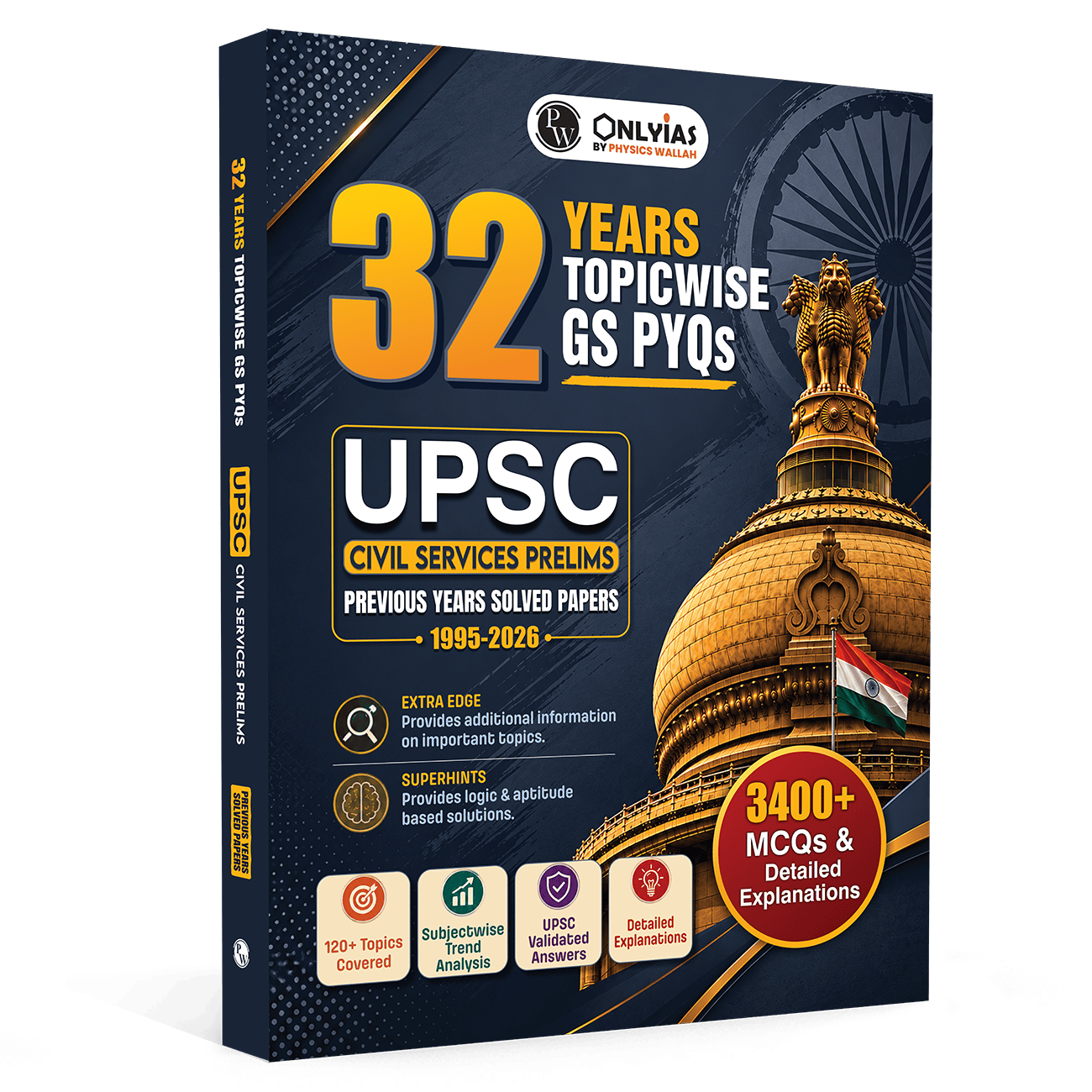
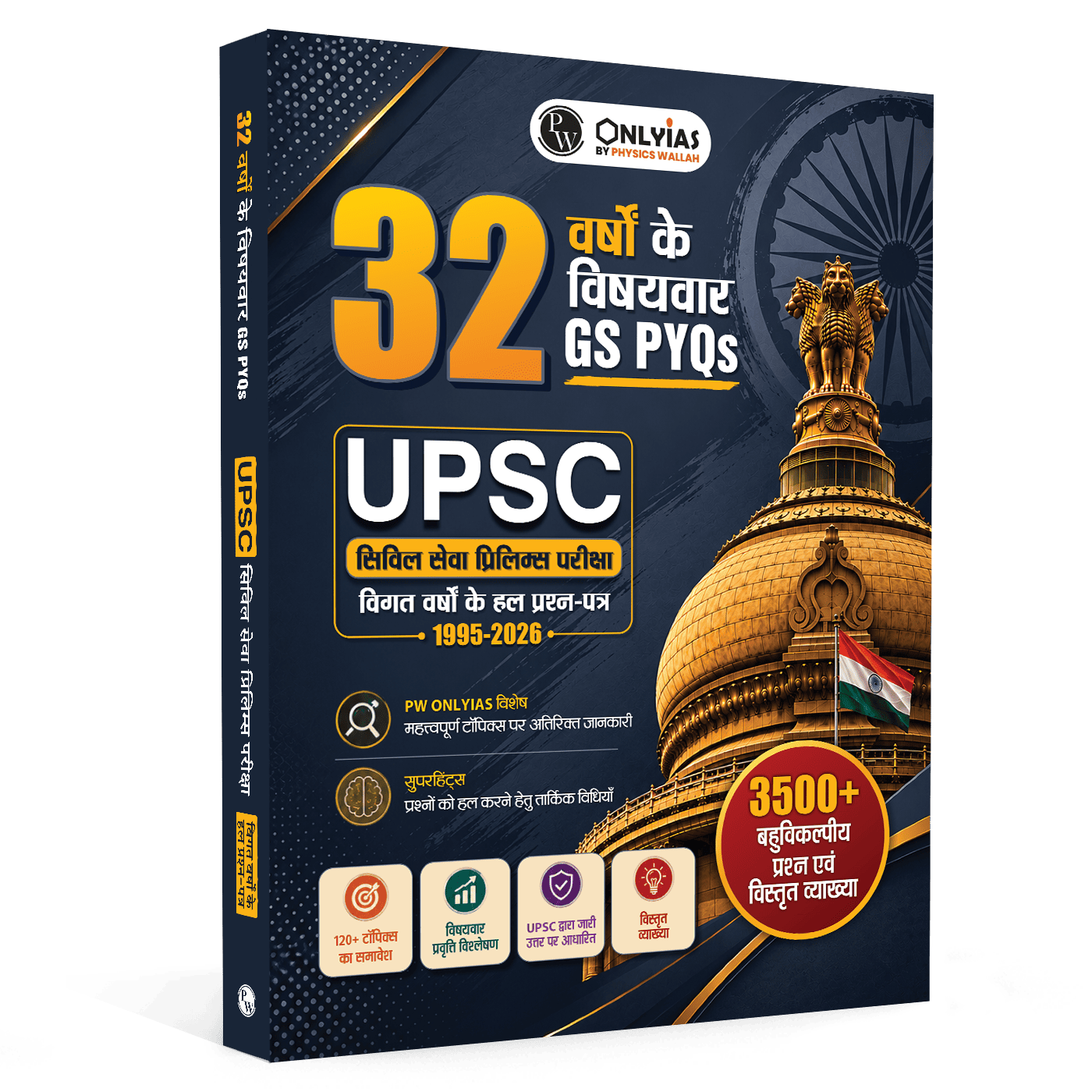
Having an accurate, error-free reference book with clear explanations is essential for effective preparation. The 32 Years UPSC GS PYQ Book (1995–2026) is designed specifically to serve as a comprehensive preparation manual.
-
32 Years Complete Coverage (1995–2026): Includes verified solved questions spanning three decades, covering both General Studies Paper 1 and CSAT Aptitude Paper 2.
-
3,400+ MCQs with Authentic Explanations: Every question is paired with expert-reviewed explanations aligned with official UPSC answer keys.
-
120+ Categorized Topics: Questions are organized into clear, subject-wise chapters to streamline topic-by-topic revision.
-
Option-Wise Explanations: Explains why the correct choice is right and provides background context on all remaining incorrect options.
-
Visual Learning Enhancements: Incorporates maps, diagrams, and thematic tables to simplify complex concepts and support memory recall.
How UPSC Prelims PYQ Shows Subject Weightage?
Analyzing three decades of data reveals how subject weightage fluctuates while remaining anchored around core pillars. The underlying UPSC exam pattern maintains stability across core General Studies subjects.
|
Subject |
Average Questions (1995–2010) |
Average Questions (2011–2026) |
Primary Focus Areas |
|
Indian Polity & Governance |
12–15 Questions |
15–20 Questions |
Constitutional Provisions, Judiciary, Rights, Parliamentary Procedures |
|
Economy & Social Development |
10–12 Questions |
15–18 Questions |
Banking, Inflation, External Sector, Agriculture, Fiscal Policy |
|
Environment & Ecology |
5–8 Questions |
15–20 Questions |
Biodiversity, Climate Agreements, Species, Protected Areas |
|
Modern Indian History |
12–15 Questions |
8–12 Questions |
Freedom Movement, Acts, Governor-Generals, Personality-based |
|
Geography (India & World) |
15–18 Questions |
10–14 Questions |
Map-based location, Physical Geography, Rivers, Resources |
|
Science & Technology |
10–12 Questions |
10–14 Questions |
Emerging Technologies, Biotech, Space, Defense, Applied Physics |
Indian Polity and Governance Trends
Polity remains one of the most predictable and high-scoring sections. Questions consistently focus on constitutional interpretations, structural governance, and civil liberties.
-
High-Yield Areas: Preamble, Fundamental Rights, Directive Principles of State Policy (DPSP), Judicial Review, Executive Powers, and Parliamentary Standing Committees.
-
Examiner Approach: Tests precise conceptual distinctions (for example, Constitutional vs Statutory bodies, Legal rights vs Fundamental rights).
Economy and Social Development Trends
Economic questions test basic macroeconomics combined with practical applications seen in daily economic updates.
-
High-Yield Areas: Inflation management, Reserve Bank of India (RBI) monetary instruments, Government Securities, Balance of Payments, Foreign Direct Investment (FDI), and international financial bodies.
-
Examiner Approach: Focuses on cause-and-effect relationships rather than memorising dry economic statistics.
Environment, Ecology, and Biodiversity Trends
Since the integration of the Indian Forest Service prelims with the Civil Services Examination in 2013, environmental questions have increased significantly.
-
High-Yield Areas: National Parks, Wildlife Sanctuaries, Biosphere Reserves, International Conventions (like UNFCCC, CITES, IUCN status), and ecological concepts.
-
Examiner Approach: Blends static geography with real-world conservation challenges and environmental legislations.
Indian History and Culture Trends
History requires a targeted strategy, as the syllabus spans Ancient, Medieval, Modern, and Art & Culture.
-
High-Yield Areas: Modern History from 1857 to 1947, Gandhian Movements, Constitutional developments under British rule, Socio-religious reform movements, and Temple architecture.
-
Examiner Approach: Tests chronology, administrative terminology, and institutional contributions of key historical figures.
Why Choose a Topic-Wise UPSC Prelims PYQ Book?
Organizing UPSC books by subject and topic gives aspirants a distinct edge over those who solve papers year by year. A systematic previous year analysis highlights exact sub-topics that yield maximum marks relative to time invested. Using topic-wise PYQs allows candidates to complete a static subject chapter and immediately test their understanding against 30+ years of authentic questions.
1. Polity & Constitution Sub-Topics
-
Constitutional Framework: Historical background, Preamble features, Basic Structure Doctrine, Amendment procedures.
-
Rights and Duties: Articles 12–35, Right to Privacy interpretations, Fundamental Duties applications.
-
Union and State Legislature: Money Bills vs Financial Bills, Parliamentary Privileges, Speaker powers, Joint Sitting conditions.
-
Judiciary: Writ Jurisdiction, Supreme Court vs High Court powers, Public Interest Litigation (PIL).
2. Economics Sub-Topics
-
Monetary Policy: Repo rate adjustments, Cash Reserve Ratio (CRR), Open Market Operations (OMO), Liquidity Adjustment Facility (LAF).
-
External Sector: Exchange Rate mechanisms, Current Account Deficit (CAD), Real Effective Exchange Rate (REER).
-
Money and Banking: Non-Performing Assets (NPAs), Insolvency and Bankruptcy Code (IBC), Digital Currency developments.
-
Agriculture: Minimum Support Price (MSP) commodities, Micro-irrigation techniques, Fertilizer subsidies.
3. Environment & Biodiversity Sub-Topics
-
Conservation Initiatives: Project Tiger, Project Elephant, Wildlife Protection Act 1972 schedules.
-
International Organizations: Global Environment Facility (GEF), UNEP, IPCC reports, Ramsar Sites criteria.
-
Pollution & Climate: Greenhouse gas sources, Particulate Matter impact, Renewable energy targets.
4. Geography Sub-Topics
-
Map-Based Questions: Rivers and their tributaries, West Asian geography, Bordering nations of major seas (Red Sea, Mediterranean Sea, Black Sea).
-
Physical Geography: Monsoon mechanisms, Cyclone formation conditions, Ocean currents.
-
Resources: Distribution of minerals, soil types in India, agricultural cropping patterns.
How to Prepare for Exams with UPSC Prelims PYQ?
Solving past questions effectively requires more than checking answer keys. A structured UPSC prelims strategy uses past papers to build intelligent elimination skills, improve time management, and identify individual weak areas.
Step 1: Integrated Topic-Wise Practise
Do not wait until two months before the exam to attempt past questions. Integrate topic-wise PYQs into daily subject preparation. When completing the "Indian Judiciary" chapter, immediately solve all Judicial questions asked from 1995 to 2026. This validates reading comprehension and highlights gaps instantly.
Step 2: Thorough Four-Option Analysis
The real value of a past question lies not only in knowing why option (A) is correct, but in discovering why options (B), (C), and (D) are incorrect.
-
Research Unfamiliar Terms: Every unknown term listed in an option should be noted down and researched briefly.
-
Track Repeating Keywords: Terms featured as incorrect choices in older papers frequently reappear as correct answers in future papers.
-
Create Flashcards: Maintain short summary flashcards for recurring terms, species, international treaties, and financial instruments.
Step 3: Recognizing UPSC Question Traps
The examiner relies on specific phrasing patterns to create distractor options. Practising 32 years of questions helps candidates recognize these traps during the live exam:
-
Extreme Statements: Words like "all", "always", "never", "only", or "drastically" frequently indicate incorrect statements, though candidates must verify context.
-
Swapped Definitions: Agencies or ministry names are often swapped (for example, attributing a Ministry of Environment initiative to the Ministry of Agriculture).
-
Numerical Reversals: Specific numerical data, inflation percentages, or dates are prone to minor adjustments by question setters to test alertness.
Step 4: Time Management and Elimination Practice
During the final two months of preparation, transition from topic-based practice to full-length 100-question timed mocks using official previous papers from recent years. This refines speed, controls negative marking, and stabilizes decision-making under exam pressure.
Read More: UPSC Syllabus
UPSC Prelims PYQ FAQs
1. How many years of UPSC Prelims PYQ should an aspirant solve?
Aspirants should ideally solve at least 25 to 32 years of past papers. While the last 10 to 15 years reflect recent question formats, analyzing 32 years provides a broader view of recurring concepts, core static themes, and fundamental option traps.
2. Do questions repeat directly in the UPSC Prelims exam?
Direct verbatim question repeats are rare in General Studies Paper 1. However, core concepts, underlying themes, and option terms repeat frequently. Mastering the background facts behind options in past papers directly helps solve new questions.
3. Should I solve PYQs topic-wise or year-wise first?
Beginners should always start with topic-wise practice alongside daily textbook reading. Once the full syllabus is covered, solving year-wise papers under strict 2-hour timed conditions helps build real exam temperament and time management.
4. How does previous year analysis help in CSAT Paper 2?
Analyzing past CSAT papers helps identify recurring problem types across Reading Comprehension, Quantitative Aptitude, and Logical Reasoning. It reveals predictable question patterns, enabling candidates to focus on high-scoring areas and secure qualifying marks comfortably.
5. Why is option-wise explanation crucial while practicing past papers?
Options in past papers often become main questions in subsequent years. Understanding why wrong options are incorrect expands conceptual knowledge and helps candidates spot distractor patterns during the exam.