UPSC EPFO and APFC Study Plan Using Previous Year Papers

You likely face the daunting challenge of balancing vast subjects like Industrial Relations, Labour Laws, and Social Security alongside standard UPSC topics. Many students struggle to identify which areas carry the most weight, leading to wasted hours on irrelevant chapters.
This is where a strategic approach using UPSC EPFO and APFC PYQ becomes your biggest advantage. By analysing past trends, you can strip away the guesswork and focus on what truly matters to the examiners. This article outlines how to integrate previous papers into your routine to build a foolproof study plan.
Check out: UPSC CSE Books
Overview of UPSC EPFO and APFC PYQ
Understanding the exam's DNA starts with looking backwards. The UPSC EPFO and APFC PYQ serve as a primary diagnostic tool to understand the difficulty level and question framing style of the Union Public Service Commission. Unlike the Civil Services Exam, the EPFO and APFC papers have a distinct flavour, focusing heavily on specific accounting principles and statutory provisions.
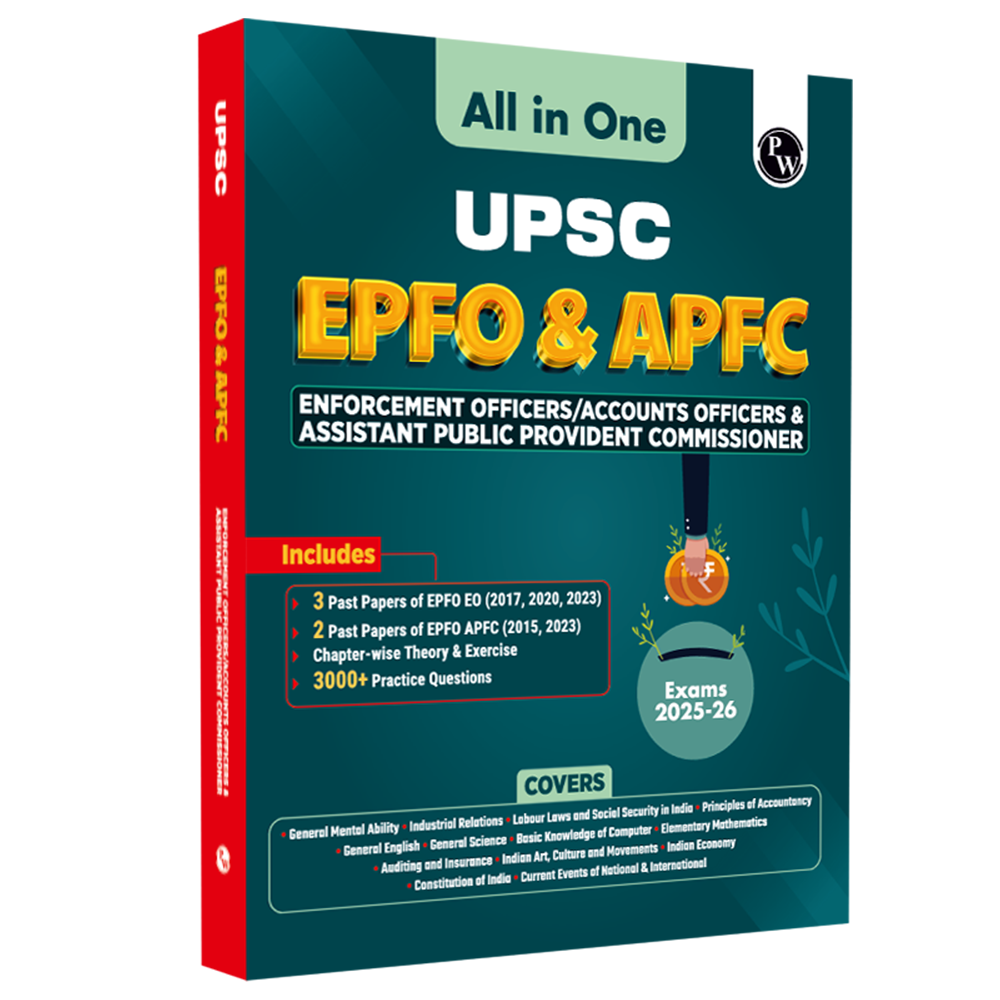
Using a dedicated UPSC EPFO book that compiles these papers allows you to see the evolution of the syllabus over the years. It helps you distinguish between the core areas that repeat annually and the peripheral topics that appear only occasionally. By reviewing a PDF or a physical book, you gain the clarity needed to prioritise your limited study hours effectively.
Features of the UPSC EPFO and APFC PYQ
To streamline your preparation, below are the features of the PYQ, which is designed to be a comprehensive companion.
-
Comprehensive Solved Papers: Includes 5 previous years' solved papers from 2015, 2017, 2020, and 2023.
-
Step-by-Step Solutions: Every UPSC EPFO & APFC PYQ is followed by a detailed explanation to ensure you understand the logic behind the correct answer.
-
Massive Question Bank: Access over 3000 objective practice questions that cover the entire syllabus comprehensively.
-
Theory Integration: It provides exam-oriented chapter-wise theory and practice questions in simple language to strengthen your conceptual base.
-
Current Affairs Access: A QR code provides exclusive access to a regularly updated monthly current affairs magazine.
How UPSC EPFO and APFC PYQ Help Students
The primary benefit of using UPSC EPFO and APFC PYQ is the elimination of "exam fear" through familiarity. When you solve actual questions from previous years, you align your brain with the examiner’s mindset.
-
Identifying High-Yield Topics: You will notice that certain sections, such as Labour Laws and General Mental Ability, have a consistent presence.
-
Clarity of Concepts: Detailed solutions in an UPSC EPFO PYQ book help you build clarity on complex topics like Auditing and Insurance.
-
Accuracy Improvement: Repeated practice helps you avoid common pitfalls and "silly mistakes" that occur under exam pressure.
-
Refining Strategy: By seeing how questions are structured, you can decide whether to approach a subject through deep theory or through objective-based practice.
How to Use UPSC EPFO and APFC PYQ for Improving Scores
Simply reading a previous year's paper is not enough; you must use it as a performance-enhancing tool.
-
Initial Benchmarking: Before you start your preparation, solve one UPSC EPFO PYQ to see where you stand. This highlights your natural strengths and weaknesses.
-
Reverse Learning: If you find a question on a topic you haven't studied, use the solution in the UPSC EPFO book to learn that concept immediately. This is often faster than reading a whole textbook first.
-
Time Management: Set a timer and solve papers in a simulated exam environment. This builds the stamina required to handle 120 questions within the allotted time.
-
Trend Analysis: Track how the weightage of Current Events versus Static GK has shifted. Use the QR-coded monthly magazine to stay updated on the latest trends.
Check Out: UPSC Textbooks
Study Plan for Using UPSC EPFO and APFC PYQ
A successful plan balances theory with relentless practice. Use this structured approach to stay on track:
|
Week |
Focus Area |
Resource Usage |
|
Weeks 1-4 |
Core UPSC Subjects (History, Polity, Economy) |
Read chapter theory + solve 10 PYQ daily. |
|
Weeks 5-8 |
Specialized Subjects (Labour Laws, Accounting, IR) |
Use the UPSC EPFO book for simplified theory and practice questions. |
|
Weeks 9-12 |
General Science, Maths, and English |
Solve objective questions to increase speed and accuracy. |
|
Week 13+ |
Full Mock Tests and Revision |
Solve 5 years of UPSC EPFO and APFC PYQ as timed tests. |
When to Use UPSC EPFO and APFC PYQ?
Timing is everything. You should integrate UPSC PYQ at three distinct stages:
The Beginning Phase
Use the papers to understand the "scope" of the exam. This prevents you from over-studying topics that are never asked.
The Middle Phase
After completing a subject, such as Industrial Relations, immediately solve all relevant questions from the UPSC EPFO PYQ PDF. This reinforces what you just learned.
The Final Phase
In the last 30 days, solve full-length papers to sharpen your recall speed. Focus on the 3000+ practice questions provided in the resource to ensure no topic is left untouched.
Read More: UPSC EPFO Syllabus for EO/AO and APFC
UPSC EPFO and APFC Previous Year Papers FAQs
1. How many years of UPSC EPFO and APFC PYQ should I solve?
It is ideal to solve at least the last 5 to 10 years of papers.
2. Is the syllabus for UPSC EPFO and APFC the same?
While there is significant overlap between subjects like Industrial Relations and Indian Culture, the APFC exam is often slightly more difficult. Using a combined UPSC EPFO and APFC PYQ resource helps you prepare for the highest common denominator.
3. Are previous year questions repeated in the UPSC EPFO exam?
Direct repetitions are rare, but the themes and concepts are frequently reused. Mastering the UPSC EPFO PYQ ensures you are familiar with the specific vocabulary and trap options the UPSC uses.
4. How should I cover current affairs for these exams?
Since these exams occur at irregular intervals, focus on the last 12-18 months of updates.