How 8 Years JEE Maths PYQ Book Sharpens Speed and Accuracy
Struggling with lengthy calculations midway through your syllabus can feel incredibly demoralising. You understand the foundational properties of calculus or algebra, yet you repeatedly run out of time during mock exams or lose marks to silly calculation errors.
This specific performance bottleneck is precisely where regular practice with real exam questions changes the game. By structuring your routine around a targeted JEE Main PYQ maths strategy, you learn to spot shortcuts, manage the clock efficiently, and build real-time problem-solving stamina.
Overview of JEE PYQ Maths
A dedicated JEE PYQ maths compilation serves as a highly reliable diagnostic tool for modern engineering aspirants. Rather than testing your knowledge with unstructured or outdated question banks, this approach focuses heavily on the actual engineering entrance trends established between 2019 and 2026. It presents a comprehensive collection of shift-wise papers that map out the exact evolution of the national-level engineering test.
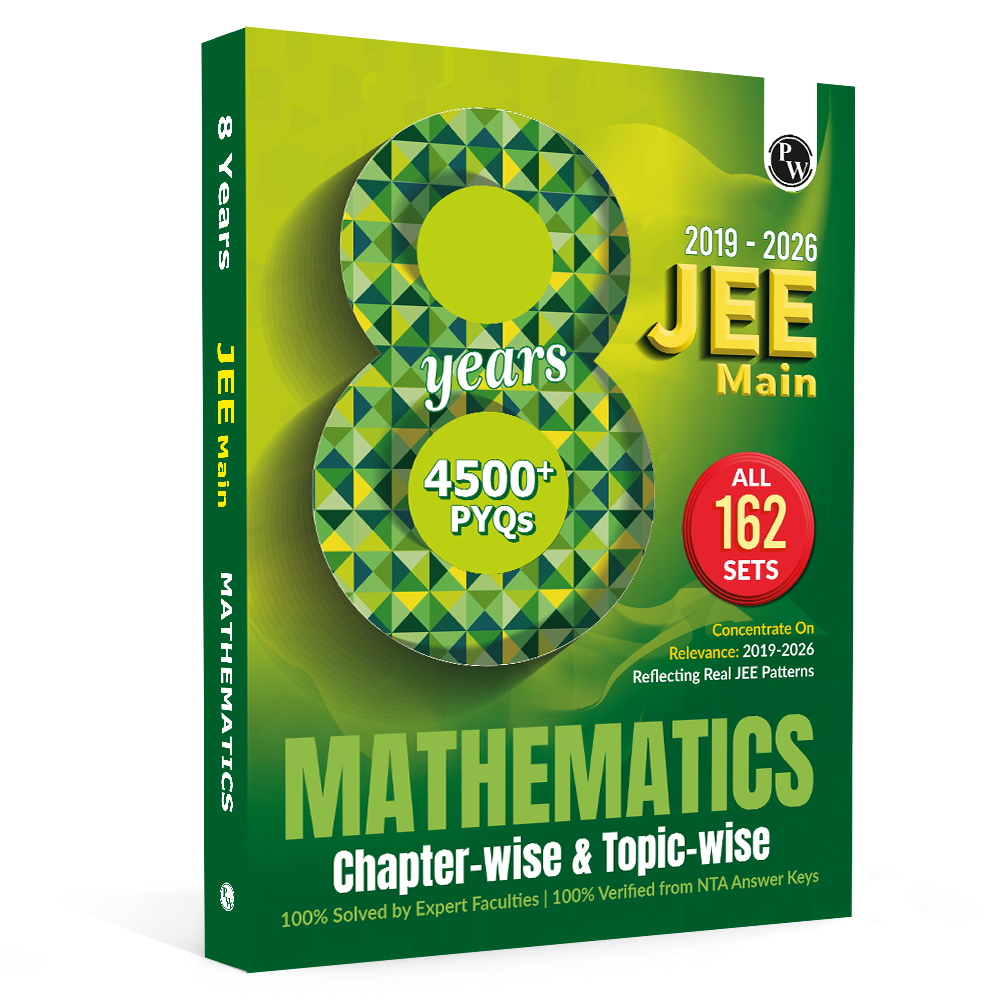
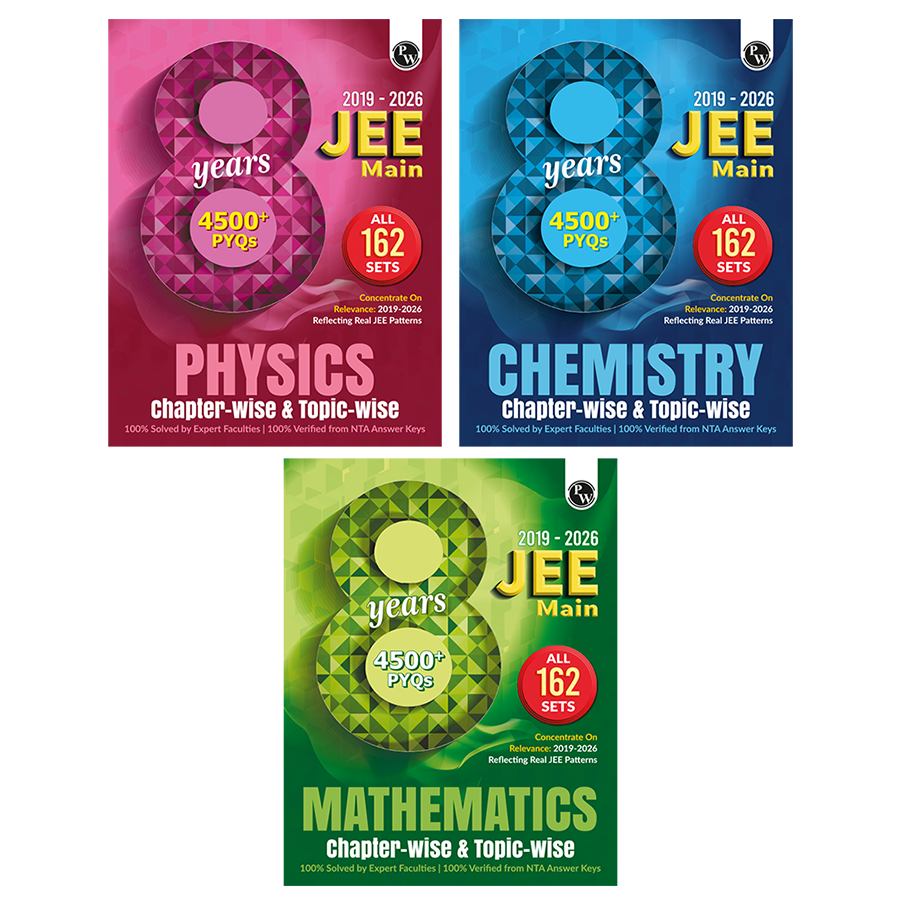
By utilizing a structured JEE Main PYQ book, candidates can access a massive pool of 13500+ questions across the entire PCM spectrum, featuring detailed, error-free solutions for over 4500+ specific mathematics problems.
This compilation brings all 162 sets of official shift papers directly to your study desk, ensuring that every hour of practice aligns perfectly with the true difficulty level of the examination.
|
Feature Type |
Resource Specifications & Details |
|
Exam Timeline Covered |
Comprehensive papers spanning from 2019 to 2026 |
|
Total Mock & Shift Sets |
All 162 shift papers included for realistic simulation |
|
Total Question Pool |
13500+ detailed questions across subjects |
|
Mathematics Question Volume |
4500+ distinct problems with step-by-step methods |
|
Question Categories |
Multiple Choice Questions (MCQs) and Numerical Value Questions |
Why Is JEE PYQ Maths Important for JEE Main?
Succeeding in this competitive national exam requires more than rote memorisation; it demands deep conceptual familiarity and analytical agility. Aspiring students often spend excessive hours reading heavy theory JEE books, only to find themselves completely blindsided by the tricky phrasing of numerical questions on exam day.
-
Realistic Evaluation: It helps you face the actual, unedited difficulty level of shift papers, steering you away from irrelevant or excessively complex non-exam material.
-
Spotting Multi-Year Patterns: It empowers you to track recurring themes, specific formula applications, and intentional traps set by the exam paper setters over the last eight years.
-
Format Familiarity: It trains your brain to transition smoothly between standard multiple-choice options and precise integer-type numerical questions.
-
Strategic Time Allocation: It allows you to discover which types of questions can be solved quickly and which ones are designed to consume your time.
How Does JEE PYQ Maths Improve Speed and Increase Accuracy?
Developing quick mental processing while maintaining zero errors is a gradual skill built through authentic maths speed improvement routines. When you practice using genuine exam questions, you train your mind to look past the surface narrative of a problem and instantly isolate the required mathematical formula.
1. Enhancing Problem-Solving Velocity
Spending too much time on a single coordinate geometry problem can easily derail your entire exam strategy. Working through multi-year question sets helps you recognise common algebraic simplifications and structural patterns rapidly. You learn to skip redundant written steps, perform minor tracking calculations mentally, and arrive at the final answer much quicker.
2. Eliminating Careless Calculation Errors
Achieving consistent high performance requires a deliberate accuracy practice routine to prevent losing easy marks to minor sign errors or algebraic slips. Reviewing highly accurate, error-free solutions helps you identify exactly where your logic deviates from the standard method.
This systematic review reinforces clean working habits, helping you sidestep common conceptual traps under intense exam pressure.
Topics Covered in JEE PYQ Maths
A comprehensive JEE previous years papers collection organises thousands of problems into highly structured, clear segments. This systematic categorization ensures you can seamlessly transition from basic foundational theories to advanced application-based question variants.
Using chapterwise maths PYQs ensures that your daily study sessions remain completely structured and focused on specific topics. The collection divides the vast syllabus into distinct, manageable segments:
-
Algebra: Covering complex numbers, quadratic equations, matrices, determinants, probability, sequences, and permutations.
-
Calculus: Ranging from fundamental limits and continuity to advanced application of derivatives, definite integrals, and differential equations.
-
Coordinate Geometry: Comprehensive coverage of straight lines, circles, parabolas, ellipses, and hyperbolas.
-
Trigonometry & Vectors: In-depth problems covering inverse trigonometric functions, three-dimensional geometry, and vector algebra applications.
How to Use JEE PYQ Maths?
Simply flipping through solved papers like a storybook will not yield significant score improvements. To truly gain an advantage from previous year maths questions, you must engage with the material actively and systematically.
-
Attempt Alone First: Always try to solve a problem completely independently for at least five to seven minutes before looking at the provided answer key.
-
Analyze the Solution Steps: If you get stuck, study the detailed solution carefully to understand the underlying logic rather than just memorising the final numerical value.
-
Highlight Critical Hurdles: Use a marker to highlight the specific step where your own logic broke down, making it easy to review later.
-
Time Your Practice Sessions: Use a stopwatch to monitor your speed, aiming to finish each individual math problem within a strict two-minute window.
-
Revisit Marked Questions: Return to your highlighted, difficult problems three to four days later to confirm you can now solve them flawlessly without any external hints.
Study Plan for Using the JEE PYQ Maths
A balanced weekly JEE maths practice schedule helps distribute your preparation evenly across intensive solving, deep structural analysis, and targeted conceptual revision:
Phase 1: Topic Isolation (Days 1 to 3)
Dedicate the opening half of your week to specific chapters that match your ongoing class schedule. Solve at least thirty distinct past questions from algebra or calculus every day. Focus your energy on understanding the core concept thoroughly rather than rushing through the problems.
Phase 2: Mixed Revision (Days 4 and 5)
Combine multiple chapters together to simulate the unpredictable layout of the actual engineering exam. Mix coordinate geometry questions alongside complex numbers to train your mind to switch between different formulas quickly and efficiently.
Phase 3: Timed Evaluation (Day 6)
Treat this day as a realistic dress rehearsal for the actual exam. Sit in a quiet room, set a strict countdown timer, and attempt a complete, unedited past shift paper without any breaks or external distractions.
Check Out: JEE Modules
Common Mistakes to Avoid While Using the JEE PYQ Maths
Many candidates inadvertently stall their own progress by adopting inefficient revision habits. Recognising these common tactical mistakes early can save you weeks of wasted effort.
-
Memorising Solutions: Avoid skimming through the step-by-step solutions blindly without actively writing down the algebraic derivations yourself.
-
Neglecting Numerical Questions: Do not focus solely on multiple-choice options; dedicate ample time to integer-type questions where you lack option clues to guide you.
-
Ignoring the Clock: Practicing without a strict timer can breed a false sense of security, leaving you unprepared for the rapid pace of the actual exam.
-
Skipping Step-by-Step Analysis: Moving on to a new chapter immediately without analyzing your current errors prevents you from correcting persistent weak areas.
Read More: How Many Hours to Study for IIT JEE?
JEE PYQ Maths FAQs
How does analyzing a JEE PYQ maths set help me spot modern exam trends?
Reviewing shift papers from 2019 to 2026 allows you to see exactly how the weightage shifts between topics, helping you identify high-priority areas and avoid outdated question patterns.
Can a single JEE Maths PYQ book cover both MCQs and numerical value questions?
Yes, a comprehensive book provides complete access to all 162 shift papers, which naturally include both multiple-choice questions and integer-type numerical problems.
What is the most reliable method to achieve maths speed improvement during self-study?
The most effective approach is to solve topic-wise questions with a strict stopwatch, gradually reducing your average target time per problem as your pattern recognition develops.