Which Physics Chapters Appear Most Frequently in NEET Over 39 Years
Preparing for the National Eligibility cum Entrance Test requires a highly structured study plan. For many medical aspirants, the physics section poses the greatest academic challenge because it requires a deep conceptual understanding combined with swift numerical calculation skills.
By focusing your attention on the most recurring topics, you can maximize your preparation efficiency and significantly boost your final score. This article highlights the high-yield sections based on historical paper data through NEET PYQ physics to help you streamline your study timeline.
Check out: NEET Books
Importance of NEET PYQ Physics
A common challenge faced by medical aspirants is managing a vast syllabus within a limited timeframe. It is practically impossible to give equal attention to every single line of the vast syllabus. This is where solving the NEET PYQ physics paper becomes an essential practice for high scorers.
Reviewing past papers reveals specific chapters that examiners favor year after year. Practizing these question sets gives you clear insights into the recurring question formats, the difficulty level of numerical problems, and how formulas are applied in real exam scenarios. This targeted strategy prevents you from wasting hours on low-yield chapters and allows you to master the high-scoring ones instead.
High Weightage Chapters in NEET PYQ Physics
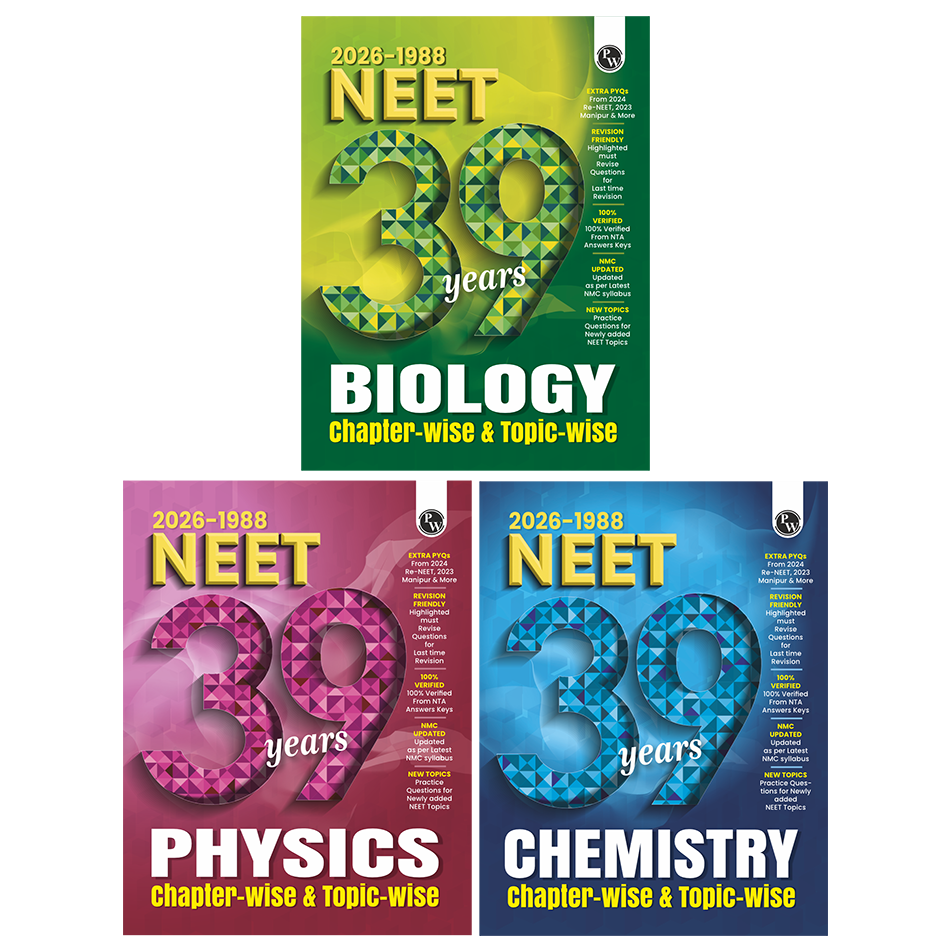
Analyzing papers from the past 39 years shows that the questions are relatively balanced between the Class 11 and Class 12 syllabus. However, Class 12 units generally carry a slightly higher weightage, contributing approximately 55% of the total questions. To understand these long-term trends more effectively and strengthen preparation with exam-oriented practice, students can also refer to the 39 Years NEET PYQ Physics resource, which helps identify recurring concepts, chapter importance, and question patterns across multiple years.
Modern Physics and Semiconductors
The Modern Physics unit is highly popular among top rankers because the questions are typically direct, structured, and formula-based.
-
Dual Nature of Radiation and Matter: Frequently features problems centered around the photoelectric effect and de Broglie wavelength calculations.
-
Atoms and Nuclei: Regularly test Bohr's atomic model, nuclear binding energy, and radioactive decay laws.
-
Semiconductor Electronics: A highly rewarding chapter that consistently yields around 2 to 3 questions on logic gates, p-n junction diodes, and zener diodes.
Electrodynamics and Current Electricity
This massive unit contributes a massive portion of the question paper each year. It demands a flawless understanding of circuit diagrams and vector applications.
-
Current Electricity: Historically, the single highest-yielding chapter in the entire exam, frequently contributing around 3 to 5 questions. Key recurring areas include Kirchhoff's laws, potentiometer experiments, and Wheatstone bridge configurations.
-
Electrostatics (Electric Charges and Capacitance): Usually contributes around 3 to 4 questions. Most questions test electric potential, Gauss's law, and combinations of parallel plate capacitors.
Optics
Optics is a visually conceptual unit that always holds a prominent position in the question distribution.
-
Ray Optics and Optical Instruments: Yields approximately 3 questions annually, focusing primarily on the lens maker's formula, total internal reflection, and microscope or telescope magnification.
-
Wave Optics: Generally yields 1 to 2 questions, with Young's double-slit experiment and polarization being the absolute favorite topics for examiners.
Mechanics
As the core foundation of Class 11 physics, Mechanics requires intense mathematical application. While it can be time-consuming, you cannot afford to skip its high-priority chapters.
-
Rotational Motion: Known as one of the tougher chapters, it consistently brings around 2 to 3 questions on the moment of inertia, torque, and angular momentum conservation.
-
Laws of Motion and Kinematics: Forms the base for all advanced physics, with frequent questions on friction, pulley systems, and projectile motion.
-
Units and Measurements: A highly scoring, simple chapter that regularly yields around 2 to 3 straightforward questions on dimensional formulas and error analysis.
Heat and Thermodynamics
This unit is highly beneficial because its core principles overlap significantly with physical chemistry.
-
Thermodynamics: Focuses heavily on the first law of thermodynamics, cyclic processes, and Carnot engine efficiency.
-
Kinetic Theory of Gases: Usually contributes around 1 to 2 direct, formula-driven numerical questions regarding the RMS speed and degree of freedom.
Chapter-Wise Analysis in NEET PYQ Physics
To make your revision structured and systematic, you can follow this general historical weightage table compiled from extensive question trends. Along with analysing chapter weightage, practising NEET Previous Year Papers helps students understand recurring question patterns, prioritise important topics, and improve exam readiness through real exam-level practice.
|
Physics Unit / Chapter |
Approximate Average Number of Questions |
Estimated Weightage Percentage |
|
Current Electricity |
4 to 5 Questions |
Around 10% |
|
Electrostatics and Capacitance |
3 to 4 Questions |
Around 7% |
|
Ray Optics and Optical Instruments |
3 Questions |
Around 6% |
|
Rotational Motion |
2 to 3 Questions |
Around 6% |
|
Semiconductor Electronics |
2 to 3 Questions |
Around 5% |
|
Units and Measurements |
2 to 3 Questions |
Around 5% |
|
Modern Physics (Dual Nature, Atoms, Nuclei) |
4 to 5 Questions |
Around 10% |
|
Magnetism and Moving Charges |
2 to 3 Questions |
Around 5% |
|
Thermodynamics and Kinetic Theory |
2 to 3 Questions |
Around 5% |
Revision Strategies for NEET PYQ Physics
Knowing the high-priority chapters is only the first step; utilizing that knowledge productively is what actually changes your final rank.
Dedicate around 80% of your intensive revision hours to mastering the high-weightage chapters highlighted through past trends. Use the remaining 20% of your time to revise lower-weightage theoretical chapters so you do not miss easier scoring opportunities.
To make this strategy more effective, students can also practise with a NEET Question Bank, which offers topic-wise questions, strengthens concept application, and helps prioritise revision based on actual exam patterns and performance gaps.
Maintain a Formula Dashboard
Physics questions are heavily numerical. Create a dedicated formula sheet for every high-frequency chapter. Note down specific variations of formulas that have repeatedly appeared in the PYQ of NEET physics papers over the last few decades.
Practice Rigorous Time Management
When solving a NEET previous year paper physics collection, always set a strict timer. Aim to solve each individual physics question in less than one minute to replicate actual exam room pressure.
Tips for Using NEET PYQ Physics
To execute this strategy successfully, you need a reliable, error-free question repository that categorizes past questions by chapter and topic.
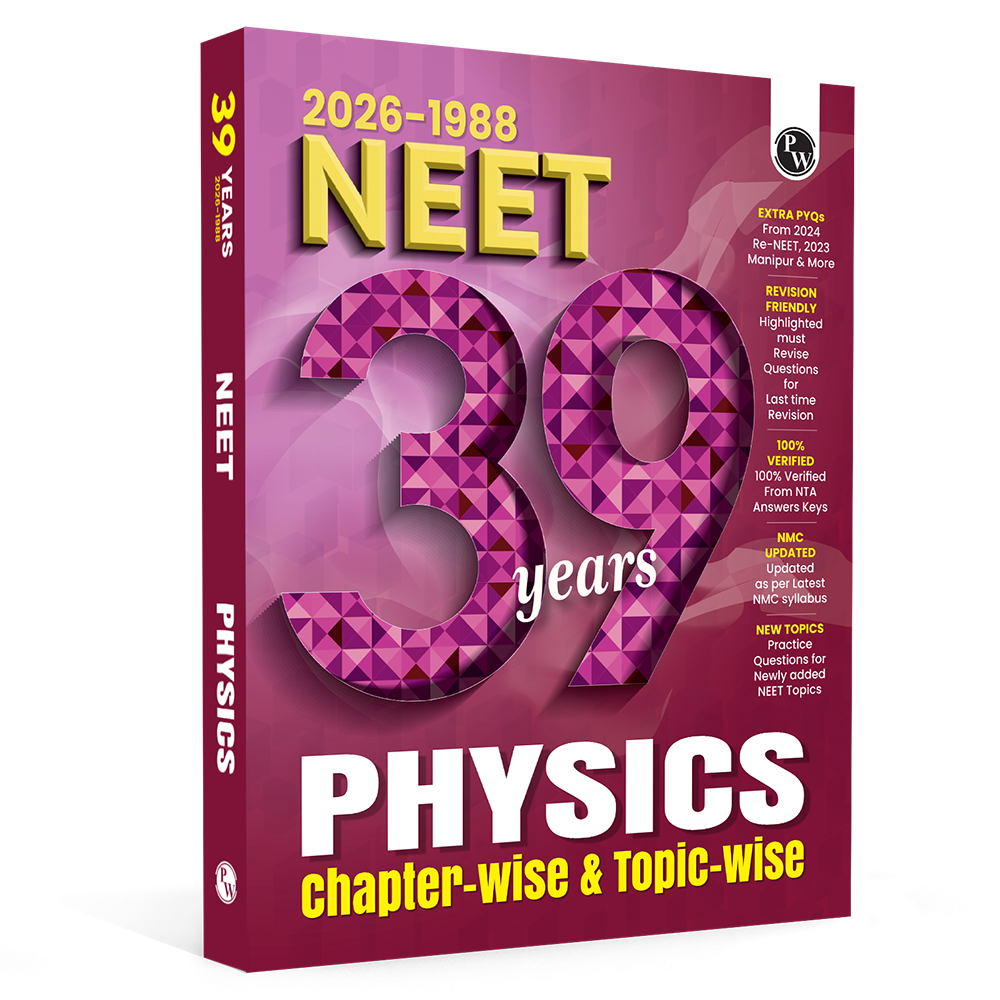
The 39 Years NEET PYQ Physics reference book serves as an excellent resource for this exact purpose. It offers comprehensive, step-by-step solutions to past papers spanning nearly four decades.
Utilizing this structured book helps you trace how the complexity of questions has evolved over the years, ensuring your practice is perfectly aligned with current exam expectations.
Read More: NEET Physics Chapter Wise Weightage 2026
NEET PYQ Physics FAQs
Which chapter has the highest weightage in the NEET PYQ physics papers?
Current Electricity has consistently emerged as the highest weightage chapter, frequently contributing around 3 to 5 questions in the examination. Key focus areas include circuit analysis, Kirchhoff's laws, and electrical measuring devices.
How helpful is solving a NEET previous year paper physics book for the final exam?
It is exceptionally helpful because around 60% to 70% of the questions in the actual exam are based directly on repeated core concepts. Working through these papers improves your speed, accuracy, and overall familiarity with the question patterns.
Can I clear the physics cutoff by studying only the high-weightage chapters?
Focusing entirely on high-yield chapters can give you a strong passing score, but skipping low-weightage chapters completely is highly risky. Even the smaller chapters often provide 1 or 2 very easy, direct formula-based questions that can boost your national rank.
Why is the PYQ NEET physics trend so important for modern physics?
Modern Physics is highly scoring because it consists of straightforward, direct theoretical and numerical questions. Tracking the previous patterns helps you identify the exact formula variants used for photoelectric effect and radioactivity questions.
Where can I find a verified compilation of the NEET PYQ physics chapter wise questions?
You can find an authentic, step-by-step collection of solved past papers in the comprehensive 39-year compilation book available on the official online store page.